VA Driver Improvement Course for Drivers Under 20
Get Your CertificateDiscover the Virginia driver improvement course designed for drivers under 20. Learn about safe driving points, classroom options, and DMV requirements.
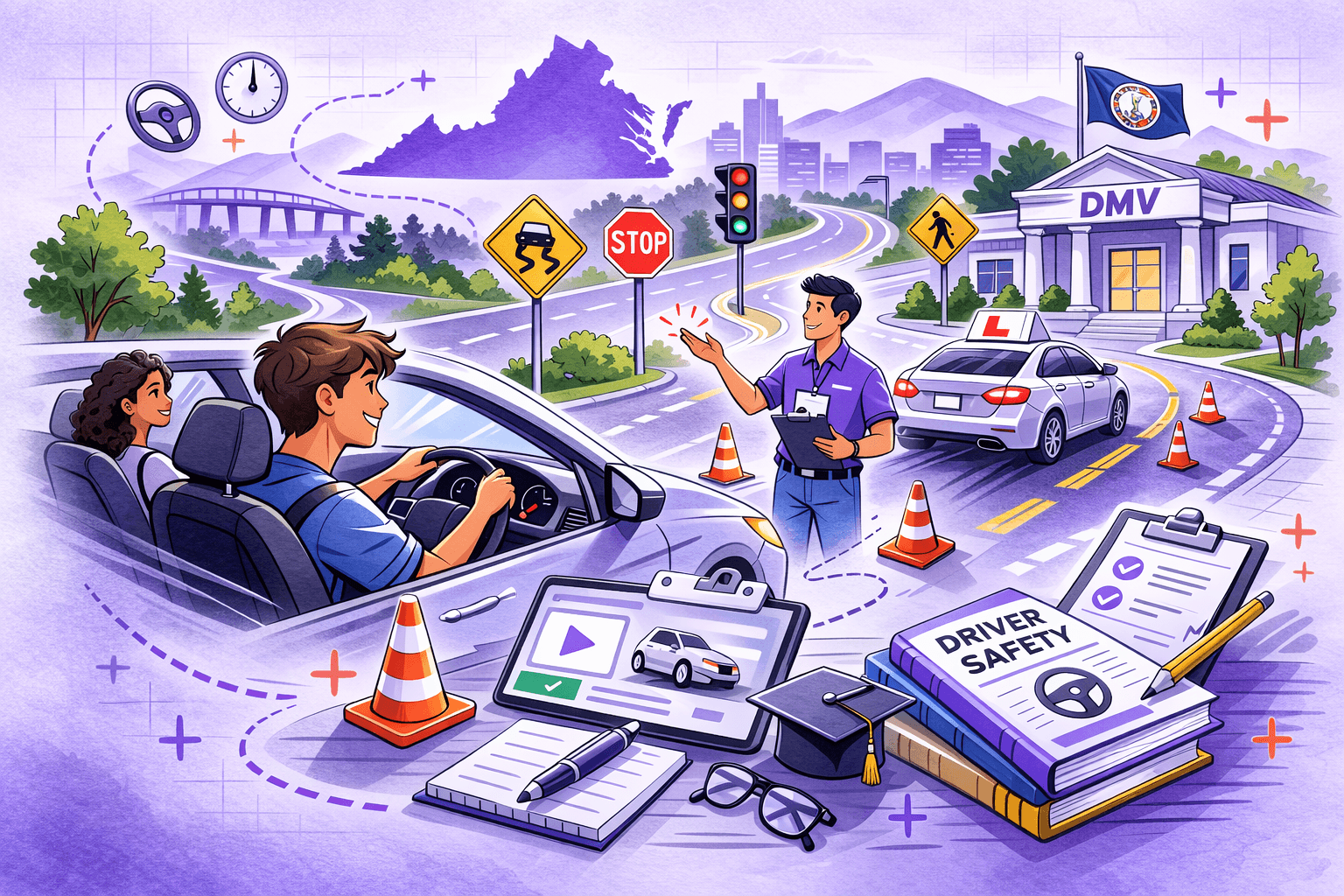
Virginia Driver Improvement Course for Under 20 Drivers
When evaluating Virginia driver improvement course, it's important to understand the key differences. Getting your first traffic violation before turning 20 can feel overwhelming—suddenly, you're dealing with points on your record, potential license suspension, and worried parents. Here's what matters: Virginia has specific requirements for young drivers that differ significantly from adult drivers, and understanding these rules could mean the difference between keeping your license and losing your driving privileges.
If you're under 20 and have accumulated demerit points on your Virginia driving record, the Virginia driver improvement course becomes more than just an option—it's often mandatory. According to the Virginia DMV, drivers under 20 face stricter thresholds: accumulate just nine demerit points within 12 months (compared to 12 for adults), and you'll receive a letter requiring course completion. This isn't about punishment; it's designed to reinforce safe driving habits during your most vulnerable years behind the wheel.
What exactly is this course? Think of it as your driving reset button. The eight-hour program covers defensive driving techniques, Virginia traffic laws, crash prevention strategies, and real-world scenarios you'll encounter on the road. The DMV approves specific providers who offer both classroom, online formats, giving you flexibility around school, and work schedules. Here's the silver lining: completing an approved Virginia driver improvement course can reduce your demerit point total by five points—once every two years when done voluntarily, or as required when mandated by the DMV. Beyond point reduction, many insurance companies offer premium discounts for course completion, potentially saving your family hundreds of dollars annually. Your temporary setback could become an opportunity to become a safer, more confident driver.
The Problem: Navigating Legal Requirements for Young Drivers
The moment you receive a letter from the Virginia DMV ordering you to complete a driver improvement course, the clock starts ticking—and confusion quickly follows. Many young drivers under 20 find themselves staring at DMV correspondence with more questions than answers: What exactly is required? Which courses count? How quickly must this be done?
Virginia's legal framework for young drivers creates a minefield of requirements that aren't always intuitive. Unlike adult drivers who might take a course voluntarily for insurance benefits, drivers under 20 often face mandatory completion deadlines tied to their violation history. Miss these deadlines, and you're looking at potential license suspension or additional penalties that compound an already stressful situation.
The driver improvement course Virginia requires must meet specific DMV approval standards—not every online course qualifies. This distinction trips up countless young drivers who sign up for generic traffic school only to discover later that their certificate won't satisfy Virginia's requirements. The DMV maintains a list of approved providers, but finding current, reliable information often feels like navigating bureaucratic quicksand.
Time pressure intensifies the problem. Most DMV requirement letters give you 30-90 days to complete the course, but coordinating schedules becomes tricky when balancing school, work, or extracurricular commitments. Traditional in-person classes require you to clear entire days, which isn't always feasible for teenagers with packed schedules.
Then there's the point system itself—a complex mechanism that affects your driving record and insurance rates. Understanding how course completion impacts your points requires decoding DMV documentation that reads more like legal code than practical guidance. For drivers under 20, getting this wrong isn't just inconvenient—it can derail your driving privileges during formative years.
Why It Matters: The Impact of Completing the Course
Completing a VA driver improvement course isn't just about checking a box—it's about protecting your driving privileges and your future. For drivers under 20, the stakes are significantly higher than for older motorists, and understanding the full impact can make the difference between maintaining your independence and losing your license.
The most immediate benefit? Point reduction. Successfully completing an approved eight-hour course removes five demerit points from your driving record. That's huge when you consider that accumulating just nine points within 12 months triggers a mandatory suspension for young drivers. If you're sitting at seven or eight points, this course quite literally saves your driving privileges.
Beyond the DMV requirements, there's the insurance angle. Teen drivers already face the highest premiums in the industry—sometimes three times what adults pay. A traffic violation can spike those rates even higher, but many insurance companies offer discounts for completing approved driver improvement programs. We're talking potential savings of 10-15% on your annual premium, which adds up quickly.
The eight-hour curriculum covers defensive driving techniques, Virginia traffic laws, and risk management strategies that most teen drivers never learned in driver's ed. You'll gain practical knowledge about identifying hazards, managing distractions, and understanding how your decisions affect road safety.
But here's what often gets overlooked: your permanent driving record. Traffic violations from your teen years don't just disappear—they can follow you into adulthood, affecting future job applications (especially positions requiring driving), college admissions processes, and even apartment rentals. Taking the course seriously demonstrates responsibility and proactive problem-solving to anyone reviewing your record down the line.
The Solution: Enrolling in an In-Person Driver Improvement Course
While online courses offer convenience, classroom driver improvement programs provide a structured, and interactive learning environment that resonates with many young drivers. For those under 20, the traditional classroom setting offers
face-to-face instruction
real-time feedback
the chance to learn from peers' questions
experiences.
Understanding Your Classroom Options
Virginia-approved in-person driver improvement courses follow the same curriculum standards as their online counterparts, covering defensive driving techniques, traffic laws, and the consequences of risky behavior. The key difference? You'll spend eight consecutive hours in a physical classroom with a certified instructor, typically on a Saturday or during a scheduled weekday session.
These courses are offered throughout Virginia at community colleges, driving schools, and DMV-approved facilities. The hands-on approach means you can ask questions immediately, participate in group discussions, and engage with driving scenarios that might feel more real than clicking through online modules.
What Makes Classroom Learning Work
For young drivers who struggle with self-paced learning or need the accountability of scheduled class time, in-person courses offer distinct advantages. The structured format keeps you engaged and prevents the temptation to rush through material. You'll complete all requirements in one day—no logging back in, no forgetting passwords, no technical glitches interrupting your progress.
However, this convenience comes with trade-offs. You'll need to arrange transportation, clear your schedule for the entire day, and pay attention for eight straight hours. Most facilities charge similar fees to online programs, typically ranging from $65-$100, but you'll lose the flexibility to pause or break up the coursework.
The choice ultimately depends on your learning style and schedule constraints.
Hypothetical Scenarios: Common Paths for Young Drivers
Understanding how other young drivers navigate Virginia's system helps clarify your own path forward. Let's walk through three common scenarios that illustrate when and why an in-classroom course under 20 becomes necessary—and how it shapes outcomes.
Scenario 1: The First Speeding Ticket
Meet Alex, a 17-year-old who received a ticket for driving 15 mph over the limit on his way to school. With three demerit points on his record, he's facing a tough conversation with his parents about insurance rates. Alex enrolls in a DMV-approved course to proactively reduce those points. By completing the eight-hour program, he subtracts five positive points from his record, effectively neutralizing the violation's impact and demonstrating responsibility to both his parents and insurance company.
Scenario 2: The Court-Mandated Course
Sarah, 19, was involved in a minor accident where she was deemed at fault. The court mandated driver improvement training as part of her case resolution. She opts for classroom instruction because she learns better through direct interaction with instructors. The structured environment helps her understand blind spot awareness and defensive driving techniques in ways that stick—skills that online modules might not have reinforced as effectively.
Scenario 3: The Proactive Learner
Jordan, 18, has a clean record but knows he's a new driver navigating challenging highway situations daily. He voluntarily enrolls in driver improvement coursework to build confidence and potentially qualify for insurance discounts. The classroom setting allows him to ask specific questions about merging techniques and adverse weather driving—practical concerns that generic materials don't always address thoroughly.
Each path demonstrates that driver improvement isn't punishment—it's preparation for safer, more confident driving.
Implementation: Successfully Completing and Benefiting from the Course
Once you've enrolled, the path to completion becomes straightforward—but maximizing the value requires more than just clicking through modules. Think of the Virginia DMV driver course as an investment in your driving future, not just a box to check.
Your completion strategy matters. Most courses break down into digestible modules covering topics like defensive driving techniques, Virginia traffic laws, and risk assessment. Here's the reality: you'll get out what you put in. Students who actively engage with scenarios—mentally placing themselves in the situations presented—retain significantly more than those who rush through. Completion typically takes between 6-8 hours depending on whether you choose an approved online program or classroom setting. Online courses offer flexibility but require self-discipline. Set aside dedicated time rather than spreading it across weeks—fragmented learning dilutes retention.
The certificate delivery process is time-sensitive. Upon passing the final exam (usually requiring 80% or higher), your completion certificate gets transmitted to the DMV within 7-10 business days. Don't assume instant processing—plan ahead if you're approaching a license suspension deadline or court date. Save your certificate and confirmation number; you'll need these for verification.
Beyond compliance, track the practical benefits. If you're pursuing safe driving points, monitor your driving record 30 days after completion to confirm the credit appeared. The real payoff? Many students report increased confidence in challenging situations—knowing how to handle aggressive drivers or adverse weather becomes second nature rather than panic.
One often-overlooked advantage: insurance companies frequently reward course completion with discounts. Contact your provider with your certificate; even a 5-10% reduction compounds significantly over time for young drivers facing premium penalties.
Limitations and Considerations
While Virginia's driver improvement course offers clear benefits for under-20 drivers, understanding its boundaries helps set realistic expectations, and avoid disappointment. The course isn't a reset button. Most importantly, completing the driver improvement program doesn't erase violations from your driving record—they remain visible for the full statutory period, typically five years. What changes is your point balance, not your violation history. Insurance companies, employers conducting background checks, and college applications requesting driving records will still see the original infractions.
Point reduction has strict timing rules. You can only earn safe driving points Virginia once every two years, regardless of how many courses you complete. Taking multiple courses within that window won't accelerate point removal—the system caps benefit frequency. Additionally, the five-point credit applies to your overall balance, not to specific violations. If you accumulate six points after completing the course, you'll carry one net point, not start fresh at zero.
Not all violations qualify for point offset. Serious offenses like reckless driving, DUI, and or driving on a suspended license carry consequences beyond the point system. Completing the course won't prevent license suspension for these major infractions, and courts maintain discretion in sentencing regardless of your participation. Think of the course as preventive maintenance, not damage control for critical violations. The under-20 restriction creates urgency. Virginia's requirement that drivers take the course before turning 20 means waiting until your birthday passes eliminates the mandatory completion option. While you can still take voluntary courses after 20, you lose access to this specific path designed for young drivers facing their first accumulation of points.
Understanding these boundaries helps you use the course strategically rather than viewing it as a universal solution to driving record challenges.
Frequently Asked Questions About Virginia's Driver Improvement Course
How long does the course take to complete?
Virginia requires either an 8 hour course delivered over a weekend or a self-paced online version that totals the same instructional time. The online format allows you to break sessions into manageable chunks—typically 30-60 minute segments—making it easier to fit around school, work, or sports commitments. Most under-20 drivers complete the online format within 2-5 days, though you technically have up to 90 days from enrollment.
Can I take the course on my phone?
Absolutely. Virginia-approved courses must function across all devices, including smartphones and tablets. The platform saves your progress automatically, so switching between your phone during lunch breaks and your laptop at home causes no issues. However, the final exam often requires a stable internet connection and larger screen for easier navigation.
What happens if I fail the final exam?
Most providers allow multiple retake attempts at no additional cost. You'll typically need to score 80% or higher to pass, but the exam draws from material you've already studied throughout the course. If you fail, review the modules where you struggled before attempting again—most students pass on their second try.
Will the DMV know I completed the course?
Yes. Your course provider electronically transmits completion data directly to the Virginia DMV within 7-10 business days. You'll also receive a certificate for your records. Double-check that your provider is DMV-approved before enrolling to ensure this automatic reporting happens.
Can I take the course to dismiss a ticket?
Only if the court specifically allows it. Driver improvement courses reduce demerit points but don't automatically dismiss traffic citations. Contact the court handling your case to determine whether completion satisfies their requirements for ticket dismissal or fine reduction.
Key Virginia Driver Improvement Course Takeaways
Completing Virginia's driver improvement course represents a proactive investment in your driving future, especially for under-20 drivers facing higher insurance premiums and stricter point accumulation rules. The course delivers tangible benefits—five points removed from your record, potential insurance discounts averaging 5%, and court-ordered point reduction when needed—while building defensive driving skills that last a lifetime.
The path forward is straightforward: Choose between an eight-hour in-person weekend course or a flexible online option that fits your schedule. Younger drivers particularly benefit from online completion, which allows learning at your own pace while managing school and work commitments. The $65 average cost becomes negligible when compared to multi-year insurance savings and the avoided consequences of license suspension.
Remember these critical points as you move forward: You can take the course voluntarily once every 24 months for points reduction, but court-ordered completions don't count toward this limit. The five-point reduction applies to your current balance—it won't create negative points, but it provides crucial breathing room if you're approaching the demerit threshold. Most importantly, your completion certificate must reach Virginia DMV within 90 days, though this responsibility typically falls on the course provider.
Your next step is simple: Visit the Virginia DMV's Driver Improvement page to find approved providers, compare course formats, and enroll. Whether you're facing mandatory completion or seeking voluntary improvement, taking action today protects your driving privileges and demonstrates the mature responsibility that separates safe drivers from statistics. Your insurance company—and your wallet—will thank you.
Dismiss Your Ticket Online
Virginia DMV-approved 8-hour driver improvement clinic. Complete at your own pace from any device.
Start Course — $74.99Why Choose ABC Driving Improvement?
Official Virginia clinic
Complete at your own pace, 24/7
Virginia drivers served
Based on verified reviews
Young drivers in Virginia face stricter penalties for traffic violations, including provisional license restrictions. Completing a driver improvement course can help teen and young adult drivers remove demerit points, avoid license suspension, and build safer habits early. Parents can also benefit from knowing the course satisfies both court-ordered and voluntary requirements for drivers under 20.
Which Course Code Do You Need?
Check your court paperwork or DMV letter for your assigned code.
Get Your Certificate