Virginia U-Turn Laws: Complete Guide to Legal Turns & Penalties
Get Your CertificateLearn where U-turns are legal in Virginia, prohibited locations, safe techniques, and penalties. Know the rules to avoid traffic tickets.
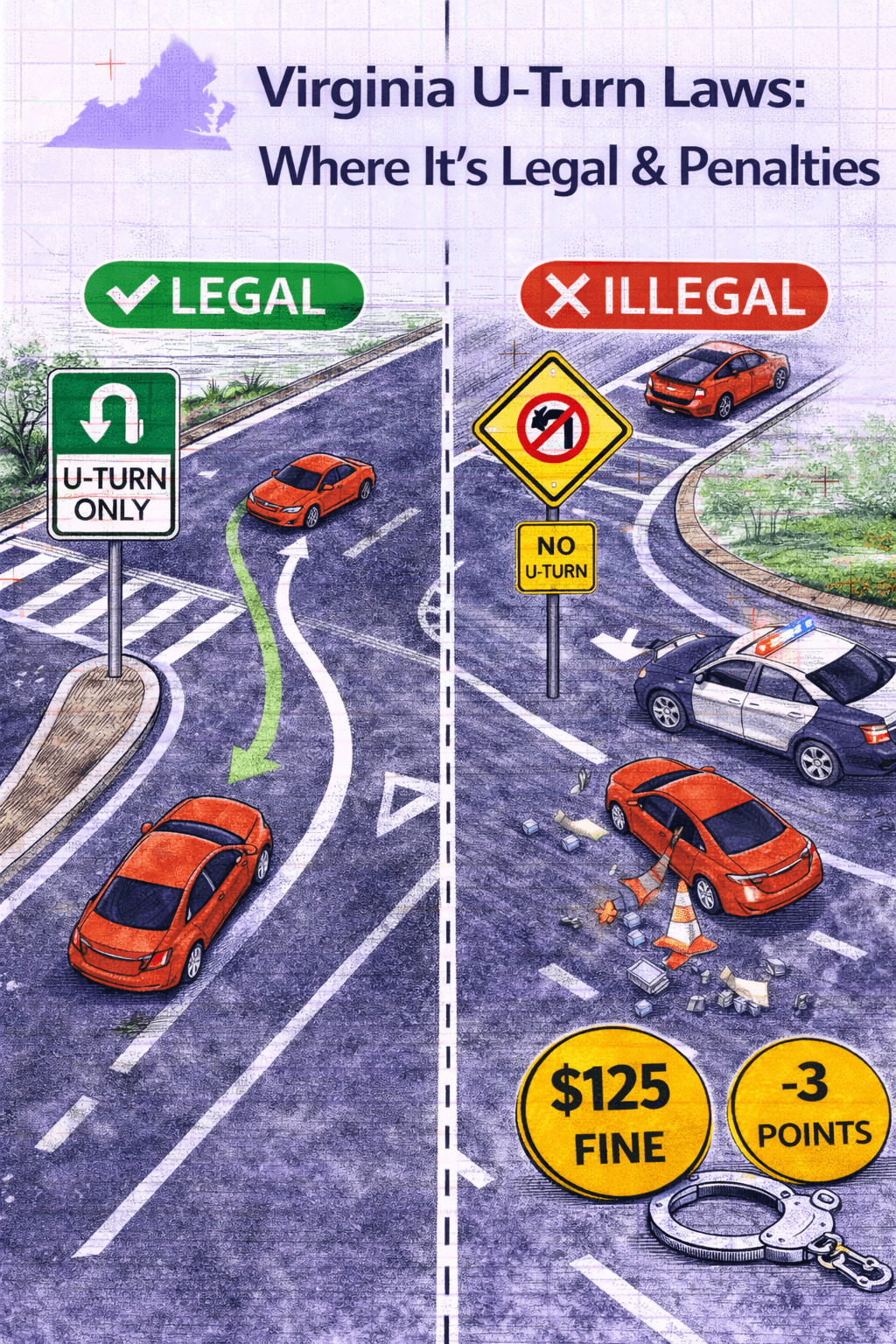
Understanding Virginia's U-Turn Regulations
U-turns are a common maneuver in everyday driving, but many Virginia drivers don't fully understand when and where they're legal. Unlike some states with blanket prohibitions on U-turns, Virginia takes a more flexible approach—U-turns are generally legal unless specifically prohibited by signage or road conditions. However, this doesn't mean you can make a U-turn anywhere. Understanding Virginia's U-turn laws, where they're prohibited, and how to perform them safely is essential to avoid traffic tickets and, more importantly, accidents.
Whether you're a longtime Virginia resident or new to the state, knowing the specifics of U-turn legality will help you navigate roads confidently and stay on the right side of traffic law.
Where U-Turns Are Generally Legal in Virginia
In Virginia, the default rule is that U-turns are legal unless posted otherwise or prohibited by specific road conditions. This means you can make a U-turn at most intersections and roadway locations, provided you do so safely and within the rules of the road.
Legal U-Turn Locations
U-turns are permitted in Virginia at:
Regular intersections: Most standard intersections with traffic lights or stop signs allow U-turns unless a "No U-Turn" sign is posted.
Two-way streets with center turn lanes: When a center turn lane is available, U-turns are typically legal as you can use the turn lane to complete your maneuver safely.
Parking lot exits: You can make a U-turn in a parking lot or driveway if it's safe and you're not blocking traffic.
Open roadways: On roads without specific restrictions, you can make a U-turn provided it's safe and you don't impede traffic.
The key principle is that U-turns must be made safely and without endangering other road users. Even if a U-turn is technically legal in a location, if you make it unsafely or without proper signaling, you can still be cited for reckless driving or improper turning.
Where U-Turns Are Prohibited in Virginia
Certain locations explicitly prohibit U-turns, and Virginia law identifies specific situations where U-turns are not permitted. Understanding these restrictions is crucial to avoid citations.
No U-Turn Signs
The most obvious restriction is a posted "No U-Turn" sign. If you see this signage, U-turns are prohibited at that location, and making one will result in a traffic violation. These signs are commonly posted at:
Busy intersections with heavy traffic
Highway exits and on-ramps
Areas with limited visibility
Downtown areas where U-turns would create traffic congestion
Near Hill Crests
U-turns are prohibited near the crest of hills where visibility is limited. A hill crest is the highest point where the road begins to descend. Making a U-turn near a hill crest creates a serious safety hazard because oncoming traffic on the other side of the hill cannot see you executing the turn. If you're caught making a U-turn near a hill crest, you can be cited for an unsafe turn, even without posted signage.
Curves with Limited Visibility
Similarly, U-turns are not permitted on curves or in areas where your visibility is significantly restricted. This includes sharp curves, areas obscured by vegetation or structures, and any location where oncoming traffic cannot see your vehicle clearly. The safety principle is clear: if you can't see oncoming traffic, they can't see you making a U-turn.
Intersections with No U-Turn Signs
Beyond general "No U-Turn" signs, some intersections may have specific restrictions. For example, certain intersections might allow left turns but not U-turns. Pay attention to all signage at intersections to understand which maneuvers are permitted.
School Crossings When Students Are Present
U-turns are prohibited at school crossings when students are present or during designated school hours. This applies both to marked school crossings and areas immediately adjacent to school property. The reasoning is clear: U-turns in these areas create unpredictable vehicle movements that can endanger students. If you're stopped for an illegal U-turn at a school crossing, the violation is taken very seriously and may result in higher fines.
Limited Access Highways
U-turns are generally prohibited on Interstate highways and other limited-access highways. These roads are designed for continuous traffic flow, and U-turns would create dangerous conflicts between vehicles. If you need to reverse direction on a limited-access highway, you must use designated exit and entrance ramps.
The Difference Between U-Turns and Three-Point Turns
A common source of confusion is the distinction between U-turns and three-point turns. Understanding this difference can help you make legal maneuvers when U-turns aren't permitted.
U-Turns
A U-turn involves turning your vehicle 180 degrees in a single smooth maneuver, typically by turning left and completing the turn in one motion. U-turns require adequate space and clear visibility.
Three-Point Turns
A three-point turn (also called a Y-turn or Austin-Healey turn) involves three separate movements: drive forward at an angle, reverse at an angle, then drive forward again to face the opposite direction. This maneuver takes more space and time than a U-turn.
Legal Implications
In locations where U-turns are prohibited, three-point turns may be legal. For example, if you're on a narrow road with a "No U-Turn" sign, you might still be able to perform a three-point turn to reverse direction. However, you must ensure the maneuver is safe and doesn't violate traffic laws. Never block traffic or create unsafe conditions while performing a three-point turn.
How to Perform a Safe U-Turn
If you're in a location where U-turns are legal, knowing how to perform one safely is essential. Poor execution can result in traffic citations or accidents.
Check Your Surroundings
Before considering a U-turn, carefully assess your environment:
Verify there are no "No U-Turn" signs
Confirm you're not on a hill crest or approaching a curve with limited visibility
Ensure you're not at a school crossing or in a school zone
Check that you're not on a limited-access highway
Check Traffic and Visibility
Look for oncoming traffic in all directions. U-turns require clearing space in the opposite lane of traffic. If traffic is heavy or visibility is compromised, wait for a safer opportunity or find an alternate route.
Signal Your Intent
Always use your turn signal at least 100 feet before executing a U-turn. Signal a left turn if you're turning left to complete the U-turn. This alerts other drivers to your intention and reduces the likelihood of collisions.
Execute Smoothly
Once you've confirmed traffic is clear, make your turn smoothly and deliberately. Avoid jerky or abrupt movements that might confuse other drivers. Complete the turn quickly but not dangerously.
Merge into Traffic
Once you've completed your U-turn, you're now traveling in the opposite direction. Ensure you merge smoothly into traffic and adjust your speed to match surrounding vehicles.
Penalties for Illegal U-Turns in Virginia
Violating Virginia's U-turn laws results in traffic citations with specific penalties that affect both your wallet and driving record.
Demerit Points
An illegal U-turn violation typically results in demerit points on your Virginia driving record. The specific number of points varies depending on the circumstances and whether additional violations (like reckless driving) are involved. Accumulating too many demerit points can lead to license suspension.
Fines
Fines for illegal U-turns generally range from $50 to $200+, depending on the location and circumstances. U-turns at school crossings or in school zones typically result in higher fines due to the increased danger to students.
Insurance Rate Increases
A traffic citation for an illegal U-turn will likely be reported to your insurance company, potentially increasing your premiums. Insurance companies view traffic violations as indicators of risky driving behavior.
License Suspension
While a single U-turn violation rarely results in immediate license suspension, repeated traffic violations can accumulate demerit points leading to suspension. In Virginia, accumulating 12 demerit points in 12 months results in a license suspension.
Common Scenarios Where Drivers Get U-Turn Tickets
Understanding typical situations that result in U-turn tickets can help you avoid them.
Missed Turns
Scenario: A driver misses their intended turn and attempts a quick U-turn to correct course.
The problem: In their haste, they don't notice a "No U-Turn" sign or fail to check for oncoming traffic, resulting in a citation.
The lesson: Plan your route and look ahead for turns. If you miss a turn, proceed to the next legal turning point rather than making an illegal U-turn.
Highway Exits
Scenario: A driver takes the wrong highway exit and attempts to U-turn to get back on the correct highway.
The problem: U-turns are prohibited on limited-access highways and at highway exits. They must use the next exit to turn around.
The lesson: Use GPS or plan your route carefully to avoid taking wrong exits. Know where your intended exit is before you need to take it.
School Zone Violations
Scenario: A driver makes a U-turn at a school crossing during school hours.
The problem: This is explicitly prohibited in Virginia and results in more serious penalties.
The lesson: Be especially cautious near schools and never make sudden direction changes in these areas.
Restricted Intersections
Scenario: A driver makes a U-turn at an intersection with a "No U-Turn" sign they didn't notice.
The problem: Lack of attention to signage results in a traffic violation.
The lesson: Always look for restrictive signage at intersections and follow posted instructions.
How U-Turn Violations Affect Your Driving Record
A traffic citation for an illegal U-turn doesn't just result in fines—it affects your driving record and can have long-term consequences. Understanding these impacts helps you appreciate the importance of following U-turn laws.
Demerit Point Accumulation
Virginia's demerit point system tracks violations on your driving record. Points accumulate over a 12-month period. Once you reach 12 points, your license is suspended. A U-turn violation typically adds points to this total.
Insurance Consequences
Insurance companies view traffic violations as risk factors. A U-turn citation suggests inattention or poor judgment, which insurers penalize with rate increases. These increases can persist for several years.
Employment Considerations
If you drive professionally or as part of your job, a traffic violation could affect your employment. Employers often review driving records, and violations may impact your job security or promotional opportunities.
License Suspension Risk
While a single U-turn violation may not immediately suspend your license, repeated violations accumulate points leading to suspension. In Virginia, a suspended license due to points accumulation typically lasts 30 days for the first suspension.
Best Practices for Safe and Legal U-Turns
To stay safe and compliant with Virginia U-turn laws:
Plan your route: Use GPS or plan your drive beforehand to avoid missed turns and rushed U-turns.
Pay attention to signage: Always look for "No U-Turn" signs and posted restrictions.
Avoid hill crests and curves: Don't make U-turns where visibility is compromised.
Be extra cautious near schools: Never attempt U-turns at school crossings during school hours.
Use turn signals: Always signal at least 100 feet before executing a U-turn.
Ensure oncoming traffic is clear: Only make U-turns when you have a clear view of oncoming traffic.
Consider three-point turns: When U-turns are prohibited but you need to reverse direction, execute a safe three-point turn instead.
Defensive Driving and Turning Safety
U-turn safety is a key component of defensive driving. Knowing when and how to make legal U-turns reduces your accident risk and keeps you compliant with Virginia traffic laws. If you want to strengthen your understanding of Virginia traffic regulations and defensive driving techniques, ABC Driving Improvement offers an 8-hour Virginia DMV-approved online driver improvement course for just $74.99. The comprehensive course covers turning safety, intersection hazard recognition, legal requirements, and practical techniques for safe vehicle operation. Enroll today to become a more confident and legally-informed driver.
Conclusion
Virginia's U-turn laws are straightforward: U-turns are generally legal unless posted otherwise or in prohibited locations. Avoid U-turns near hill crests, on curves with limited visibility, at school crossings during school hours, on limited-access highways, and anywhere "No U-Turn" signs are posted. Always signal before turning, ensure oncoming traffic is clear, and use three-point turns as an alternative when U-turns aren't permitted. Violating U-turn laws results in demerit points, fines, insurance increases, and potential license suspension. By understanding these regulations and practicing safe turning techniques, you'll stay safe on Virginia roads and avoid costly traffic citations.
Dismiss Your Ticket Online
Virginia DMV-approved 8-hour driver improvement clinic. Complete at your own pace from any device.
Start Course — $74.99Why Choose ABC Driving Improvement?
Official Virginia clinic
Complete at your own pace, 24/7
Virginia drivers served
Based on verified reviews
Which Course Code Do You Need?
Check your court paperwork or DMV letter for your assigned code.
Get Your Certificate