Virginia Seatbelt Laws 2026: Fines, Exemptions & Safety
Get Your CertificateComplete guide to Virginia's seatbelt laws including primary enforcement, fines, child restraint requirements, and safety statistics.
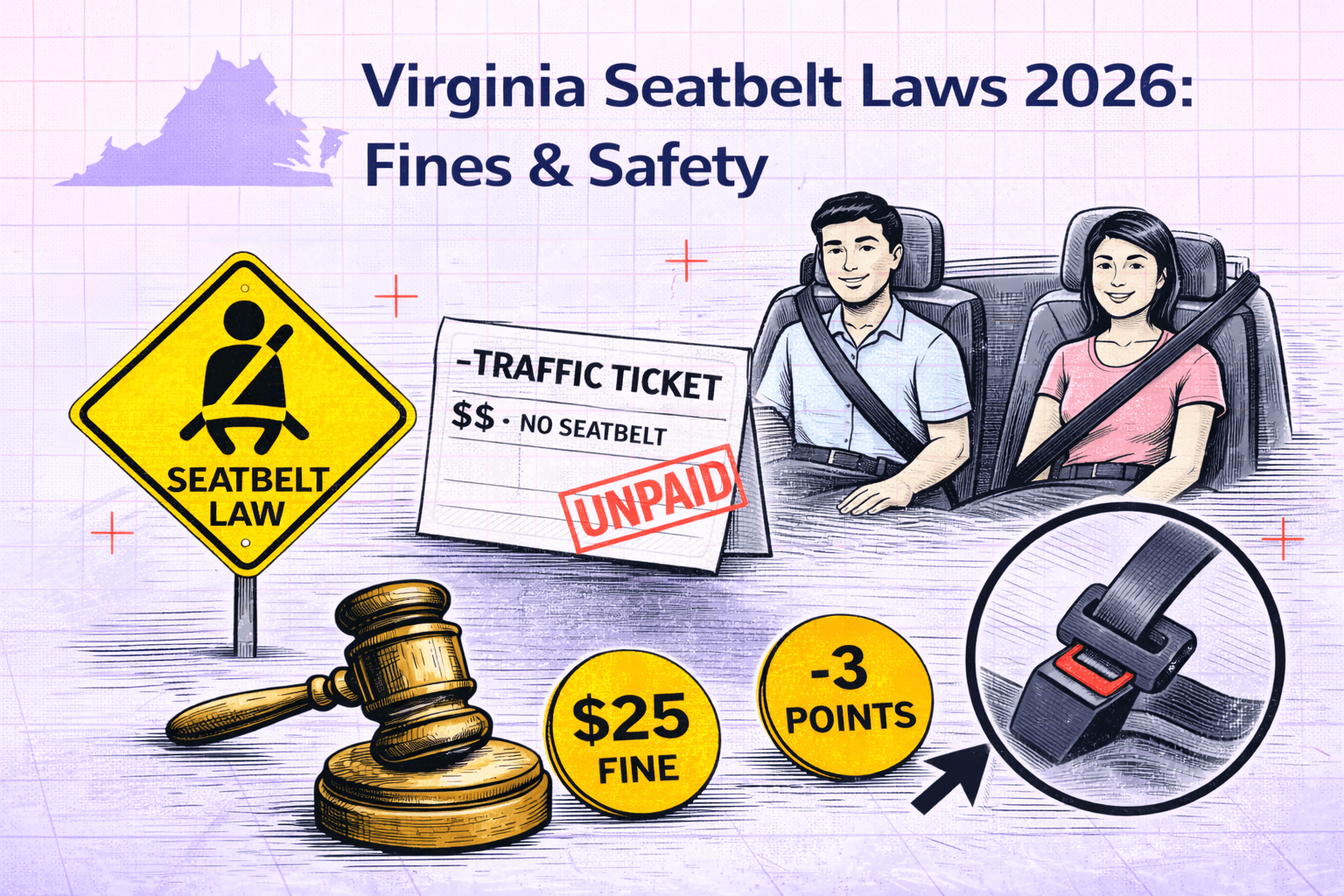
Virginia Seatbelt Laws 2026: What Every Driver Needs to Know
Seatbelts save lives. This simple fact is supported by decades of scientific research and crash data. Virginia recognizes the life-saving importance of seatbelts and has established comprehensive seatbelt laws to encourage their use. Understanding Virginia's seatbelt requirements, penalties for non-compliance, and exemptions can help keep you and your passengers safe while keeping you compliant with the law.
Virginia's Mandatory Seatbelt Law: Primary Enforcement
Virginia has a primary seatbelt law, meaning law enforcement officers can pull you over and cite you solely for not wearing a seatbelt. You don't need to be stopped for another violation first; seatbelt non-compliance alone is sufficient grounds for a traffic stop.
The law applies to:
All front-seat passengers in all vehicles
All occupants in vehicles manufactured after a certain date
Drivers on all Virginia roads (local streets, highways, interstates)
This primary enforcement approach is one of the most effective ways to increase seatbelt usage, as it removes the excuse that officers won't enforce the law unless another violation occurs.
Seatbelt Violation Fines in Virginia
If you're cited for failing to wear a seatbelt in Virginia, the penalties are:
First Offense: $25 fine
Subsequent Offenses: Fines may increase, and penalties may be more severe
Court Costs: Additional court costs are added to the fine
While $25 may seem like a modest fine, it's important to understand that a seatbelt violation appears on your driving record and can be considered when determining your insurance rates and eligibility for certain programs. Additionally, if you're involved in an accident and weren't wearing a seatbelt, the violation could strengthen a liability claim against you.
Child Restraint Laws in Virginia
Virginia has specific requirements for protecting children in vehicles. These requirements are stricter than adult seatbelt laws and reflect the special vulnerability of young passengers:
Rear-Facing Car Seats (Birth to Age 2): Children from birth until age two must ride in rear-facing car seats. This position provides the best protection for an infant's head, neck, and spine in the event of a crash.
Forward-Facing Car Seats (Age 2 to 8): Once a child reaches age two and exceeds the height and weight limits of their rear-facing seat, they must transition to a forward-facing car seat with a harness, which should be used until approximately age eight.
Booster Seats (Age 8 and Beyond): Children typically remain in booster seats until they reach 4'9" in height, which is usually around age eight. The booster seat positions the seatbelt correctly across the child's chest and pelvis.
Rear Seating: Children under 12 years old should ideally ride in the rear seat of the vehicle, as the backseat is significantly safer than the front seat in most accident scenarios.
Failure to properly restrain a child in Virginia can result in fines of up to $250 and citations that appear on your driving record. More importantly, proper child restraints reduce the risk of serious injury or death in accidents by over 70% for infants and toddlers and 50% for older children.
Seatbelt Exemptions in Virginia
While Virginia's seatbelt law is comprehensive, there are limited exemptions:
Medical Exemptions: Drivers and passengers with documented medical conditions that make seatbelt use medically inadvisable may be exempt. This requires documentation from a healthcare provider.
Certain Vehicles: Some older vehicles or specialty vehicles (such as certain farm equipment or emergency vehicles) may be exempt from requirements.
Passengers in the Rear Seat: While strongly encouraged, seatbelt use in rear seats is not legally required in Virginia for adults, though it is highly recommended.
Medical exemptions are rare and require proper documentation. If you believe you qualify for a medical exemption, contact the Virginia DMV for guidance on the documentation required.
Seatbelt Defense in Civil Cases
If you're injured in an accident and file a civil lawsuit for damages, Virginia law allows defendants to argue that your failure to wear a seatbelt contributed to your injuries. This is called a "seatbelt defense" or "comparative fault argument."
For example, if you're hit by another driver but weren't wearing your seatbelt, the at-fault driver's insurance company might argue that some of your injuries would have been prevented or reduced if you'd been restrained. While this doesn't eliminate the other driver's liability, it could reduce the damages awarded to you by 5-30% depending on the court's assessment of how much your injuries were worsened by not wearing a seatbelt.
This legal principle provides additional incentive to wear your seatbelt every time you drive, even for short trips.
Seatbelt Effectiveness: The Statistics
The evidence supporting seatbelt use is overwhelming:
Fatality Reduction: Seatbelts reduce the risk of death for front-seat occupants by approximately 45% and reduce the risk of serious injury by 50%.
Crash Survival: In a severe crash, unbelted occupants are roughly five times more likely to be ejected from the vehicle than belted occupants, and ejection is almost always fatal.
Secondary Injuries: Unbelted occupants can impact the steering wheel, dashboard, or windshield, causing head injuries, internal injuries, and spinal trauma.
Children Specifically: For children, proper restraints in rear seats reduce the risk of death by 54% compared to lap belts alone and reduce serious injury risk by 76%.
National Statistics: Approximately 14,000 lives are saved annually in the United States by seatbelt use.
These statistics consistently demonstrate that seatbelts are one of the single most effective safety devices in vehicles. No destination is worth the risk of traveling unrestrained.
Virginia's Click It or Ticket Campaigns
Virginia's "Click It or Ticket" campaign is a coordinated law enforcement effort to increase seatbelt usage and reduce traffic fatalities. During campaign periods, law enforcement agencies throughout Virginia increase seatbelt enforcement with saturation patrols and high-visibility initiatives.
These campaigns typically occur several times per year and are often announced in advance. During these periods, expect increased traffic stops for seatbelt violations. The goal is not revenue generation but rather saving lives by increasing compliance with seatbelt laws.
If you receive a citation during a Click It or Ticket campaign, remember that the officer is enforcing a law designed to protect you and your passengers. Consider it a warning to make seatbelt use a permanent habit.
Seatbelt Violations and Your Driving Record
Unlike some traffic violations, seatbelt violations do not result in demerit points on your Virginia driving record. This is an important distinction because demerit points can accumulate and lead to license suspension if you accumulate too many within a certain period.
However, a seatbelt violation still:
Appears on your driving record
May be considered by insurance companies when calculating your rates
Can be used as evidence in civil litigation if you're involved in an accident
Demonstrates a disregard for traffic safety laws to potential employers
So while you won't lose points toward license suspension, a seatbelt violation still has consequences that justify compliance.
Best Practices for Seatbelt Safety
Beyond legal compliance, follow these seatbelt safety practices:
Buckle Up Before Starting: Make it a habit to fasten your seatbelt before you start the engine every single time.
Adjust the Belt Properly: The lap belt should fit snugly across your hips, not your stomach. The shoulder belt should cross your chest, not your neck.
Check Passenger Compliance: Before driving, ensure all passengers, especially children, are properly restrained.
Use Age-Appropriate Restraints for Children: Follow Virginia's child restraint requirements based on age and size.
Replace After Accidents: If you've been in an accident, replace your seatbelts even if they appear functional, as their integrity may be compromised.
Maintain Your Seatbelts: Check that seatbelts retract and release smoothly and that there are no cuts or frays in the webbing.
Combining Seatbelts with Other Safety Measures
Seatbelts are your primary protection in an accident, but they work best combined with other vehicle safety features:
Modern airbags are designed to work with seatbelts, not as replacements
Electronic stability control helps prevent loss-of-control accidents
Anti-lock brakes improve stopping power in emergency situations
Defensive driving skills help you avoid accidents altogether
The safest approach to driving combines proper restraint use, vehicle safety features, and defensive driving habits.
Improving Your Driving Safety and Knowledge
Understanding Virginia's seatbelt laws is part of being a responsible driver. ABC Driving Improvement's 8-hour Virginia DMV-approved online driver improvement course covers seatbelt laws, child safety requirements, and comprehensive defensive driving techniques. The course costs just $74.99 and can be completed entirely online at your own pace.
Taking a driver improvement course demonstrates your commitment to safe driving and can help you:
Reduce demerit points on your driving record
Receive insurance discounts from some providers
Stay current with Virginia traffic laws and safety requirements
Improve your overall driving knowledge and skills
Conclusion
Virginia's seatbelt laws reflect the state's commitment to traffic safety. Whether you're driving alone, with passengers, or with children, using proper restraints is non-negotiable. The $25 fine for seatbelt violations is modest compared to the real cost of serious injury or death.
Make seatbelt use automatic for yourself and require it of all your passengers. For children, ensure you use the age-appropriate restraint system recommended by Virginia law. These simple steps can save your life and the lives of those you care about.
To learn more about Virginia's traffic laws, seatbelt requirements, and defensive driving techniques, enroll in ABC Driving Improvement's 8-hour online course today for just $74.99. Our Virginia DMV-approved course is comprehensive, convenient, and affordable.
Dismiss Your Ticket Online
Virginia DMV-approved 8-hour driver improvement clinic. Complete at your own pace from any device.
Start Course — $74.99Why Choose ABC Driving Improvement?
Official Virginia clinic
Complete at your own pace, 24/7
Virginia drivers served
Based on verified reviews
Which Course Code Do You Need?
Check your court paperwork or DMV letter for your assigned code.
Get Your Certificate