Virginia Right of Way Laws: Who Goes First at Intersections?
Get Your CertificateLearn Virginia right of way rules at 4-way stops, roundabouts, and T-intersections. Understand penalties and how driver improvement courses help.
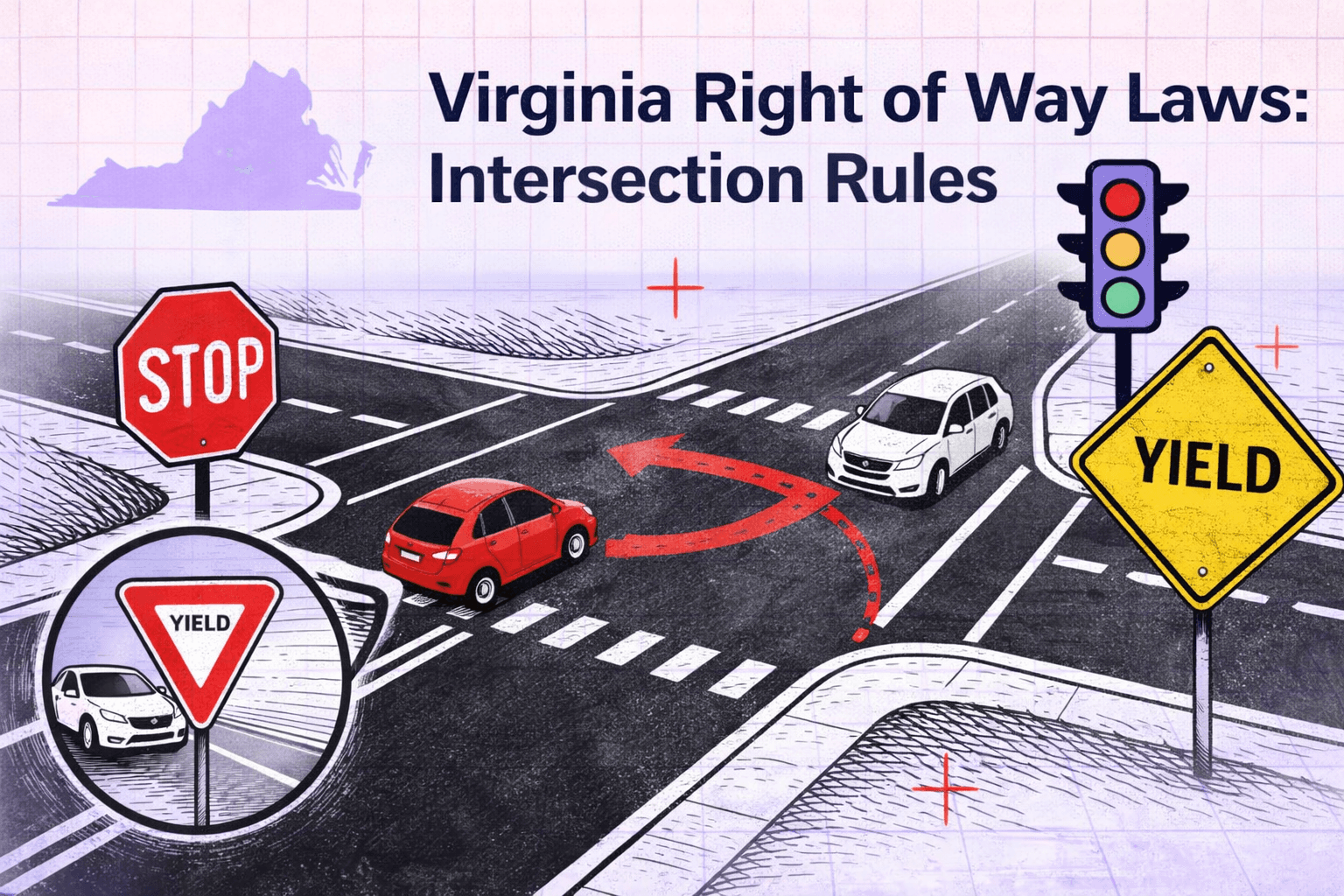
Understanding Right of Way in Virginia
Right of way is one of the most fundamental concepts in traffic law, yet it's one that many drivers misunderstand or ignore. In Virginia, right of way determines which driver must yield to another vehicle when two or more drivers reach the same location simultaneously or nearly so. Failure to yield the right of way is a serious violation that can result in demerit points, fines, and worse—accidents that injure or kill people.
Every year, thousands of traffic accidents occur at intersections across Virginia, many due to drivers who don't understand or respect right of way rules. These collisions range from minor fender benders to catastrophic crashes. Understanding right of way isn't just about following the law; it's about protecting yourself, your passengers, and everyone sharing the road.
Right of Way at 4-Way Stop Signs
A 4-way stop is one of the most common intersection configurations in Virginia, yet many drivers don't know the proper procedure. When all four directions have stop signs, the rules are clear but require driver awareness:
First Come, First Served: The first driver to reach the intersection has the right of way. If you arrive first and have completely stopped, you may proceed through the intersection before other vehicles.
Simultaneous Arrival: If two or more vehicles arrive at the same time, the vehicle on the right has the right of way. This is crucial to remember. If you're facing another vehicle head-on with no vehicle to your left, you must yield.
Turning Vehicles Yield: If a vehicle is turning left and another is going straight, the straight-moving vehicle has the right of way, even if you arrived at the same time.
Complete Stop Required: Many Virginia drivers roll through stop signs or don't come to a complete stop. You must bring your vehicle to a complete stop before the stop line, and you cannot proceed until it's clearly your right of way.
A common mistake Virginia drivers make is assuming they can proceed if the cross traffic hasn't moved. This is dangerous. Always make eye contact with other drivers, confirm they're stopping, and proceed only when you're certain the intersection is safe.
Uncontrolled Intersections and the Basic Right of Way Rule
When an intersection has no traffic signals or stop signs—what's called an uncontrolled intersection—Virginia's basic right of way rule applies: yield to the vehicle on your right. This is fundamental to Virginia traffic law.
If you're approaching an uncontrolled intersection and a vehicle is coming from your right, you must yield and let that vehicle pass. This rule applies regardless of which direction you're going. If you're turning left or going straight, it doesn't matter—the vehicle on your right always has the right of way at an uncontrolled intersection.
Uncontrolled intersections are becoming less common in Virginia as communities upgrade intersections with traffic signals and stop signs, but they still exist in rural areas and smaller roads. Drivers unfamiliar with this rule often cause collisions at these intersections.
Navigating Roundabouts and Traffic Circles
Roundabouts (also called traffic circles or rotaries) have specific right of way rules that differ from traditional intersections. Virginia law gives the right of way to vehicles already in the roundabout over those entering:
Yield When Entering: If you're entering a roundabout, you must yield to all traffic already circulating in the roundabout. Look left and don't enter until there's a safe gap.
Maintain Your Lane: Once you're in the roundabout, stay in your lane. Don't weave in and out of lanes, and don't try to change lanes multiple times.
Exit When Safe: Signal your intention to exit before you leave the roundabout. Check your mirror and blind spot before exiting.
Don't Stop in the Roundabout: Keep moving through the roundabout. There should be no stop signs inside the circle. If traffic is heavy, continue circulating until you can safely exit.
Many Virginia drivers are still learning how to use roundabouts, especially those installed in recent years. The key is to remember: yield when entering, stay in your lane, signal your exit, and keep moving.
Right of Way at T-Intersections
T-intersections—where one road terminates at another—have specific right of way rules. If you're coming from the road that ends (the stem of the T), you must yield to traffic on the main road. This applies regardless of whether there are stop signs:
The terminating road almost always has a stop sign, requiring drivers to yield to traffic on the main road.
Vehicles on the main road have the right of way in all directions.
If you're turning left off the terminating road, you must wait for a gap in traffic, even if no vehicles are coming from your right.
Yielding When Turning Left
Left turns are involved in a significant number of Virginia traffic accidents, largely because many drivers don't properly yield. The rule is clear: when turning left at an intersection with a traffic signal, yield to oncoming traffic. Even if you have a green light, you don't have an automatic right of way to turn left in front of oncoming traffic.
At a green light, you may enter the intersection, but you must wait for a gap in oncoming traffic before completing your turn. If the light turns red while you're in the intersection, complete your turn if safe, but don't proceed if oncoming traffic is approaching.
At a left turn arrow (protected left turn), you have the right of way. Oncoming traffic will be stopped by a red light, so you can safely complete your turn.
Yielding to Pedestrians
Pedestrians have the right of way in many situations in Virginia. You must yield to pedestrians:
In Marked Crosswalks: When a pedestrian is in a marked crosswalk, you must yield, whether or not there's a traffic signal.
At Pedestrian Signals: When a pedestrian walk signal is showing, pedestrians have the right of way.
At Intersections Without Traffic Signals: You must yield to pedestrians in the roadway at an intersection without traffic signals.
Outside Marked Crosswalks: Even outside a marked crosswalk, you must yield to pedestrians already lawfully in the roadway.
Failing to yield to a pedestrian can result in serious injury or death, as well as significant legal liability. Many Virginia drivers don't yield to pedestrians, especially those crossing against the light. However, Virginia law still requires you to exercise due care and avoid hitting a pedestrian if possible, even if they're crossing illegally.
Yielding to Emergency Vehicles
When you hear a siren or see flashing emergency lights, you must yield the right of way to emergency vehicles (police, fire, ambulance). Virginia law requires you to:
Pull to the right side of the road and stop.
Don't follow the emergency vehicle at a close distance.
Don't use the emergency vehicle's right of way to move through traffic.
Failing to yield to an emergency vehicle is a violation and can impede emergency response to critical situations.
Common Mistakes Virginia Drivers Make
Right of way violations are among the most common traffic violations in Virginia. Here are mistakes we see repeatedly:
Rolling Stops: Drivers don't come to a complete stop before the stop line, then proceed without checking for other traffic.
Not Checking Blind Spots: Before proceeding at an intersection, drivers don't adequately check for pedestrians or other vehicles in their blind spots.
Assuming Eye Contact Means Safe to Go: Making eye contact with a driver doesn't guarantee they'll yield. Always verify that traffic has stopped or is slowing.
Turning Without Confirming No Oncoming Traffic: Drivers turn left without waiting for oncoming traffic to pass, assuming they can "squeeze in."
Not Yielding at Roundabouts: Drivers entering roundabouts don't yield to circulating traffic, causing near-misses and collisions.
Ignoring Pedestrians: Drivers don't yield to pedestrians in crosswalks or when turning, causing pedestrian injuries.
Virginia Penalties for Failure to Yield
Failure to yield violations in Virginia carry serious consequences beyond just a fine:
Demerit Points: A failure to yield violation adds 4 demerit points to your Virginia driving record. Accumulating points can lead to license suspension.
Fines: You can be fined up to $350 for a failure to yield violation.
Insurance Increases: Your insurance company will likely increase your rates following a failure to yield citation.
Accident Liability: If your failure to yield causes an accident, you're liable for damages to other vehicles and injuries to other people.
Criminal Charges: If your failure to yield causes serious injury or death, you can face criminal charges beyond traffic court.
How a Driver Improvement Course Helps Reinforce Right of Way Rules
Virginia's approved driver improvement courses, like those offered by ABC Driving Improvement, are designed to help drivers understand and internalize traffic safety rules, including right of way. These courses cover:
Detailed explanations of Virginia's right of way rules with real-world scenarios.
Common mistakes and how to avoid them.
Safe driving practices that prevent accidents.
How to handle complex traffic situations.
Taking a driver improvement course demonstrates to the court and your insurance company that you're committed to safe driving. For Virginia drivers with violations, a course completion can sometimes help reduce points on your record or insurance impact.
ABC Driving Improvement offers a comprehensive 8-hour online driver improvement course for just $74.99. Our course is 100% online, DMV-approved in Virginia, and covers all aspects of defensive driving, including detailed instruction on right of way rules, intersection safety, and pedestrian awareness. You can take the course on your own schedule, and upon completion, you'll receive a certificate to submit to the court or your insurance company.
Conclusion: Drive Safely and Respectfully
Right of way rules are fundamental to safe driving in Virginia. By understanding who goes first at intersections, you can avoid collisions, reduce your risk of accidents, and protect yourself and others on the road. Remember: when in doubt, yield. It's always better to let another driver go first than to risk a collision.
If you've received a traffic ticket or just want to improve your driving skills, consider enrolling in ABC Driving Improvement's online course. Our 8-hour DMV-approved course is designed for Virginia drivers and covers all the rules you need to know for safe driving. Enroll today at abcdrivingcourse.com for just $74.99.
Dismiss Your Ticket Online
Virginia DMV-approved 8-hour driver improvement clinic. Complete at your own pace from any device.
Start Course — $74.99Why Choose ABC Driving Improvement?
Official Virginia clinic
Complete at your own pace, 24/7
Virginia drivers served
Based on verified reviews
Which Course Code Do You Need?
Check your court paperwork or DMV letter for your assigned code.
Get Your Certificate