Virginia Red Light & Stop Sign Violations: Fines & Points
Get Your CertificateUnderstand Virginia red light and stop sign violation penalties, demerit points, fines, and how a driver improvement course may help.
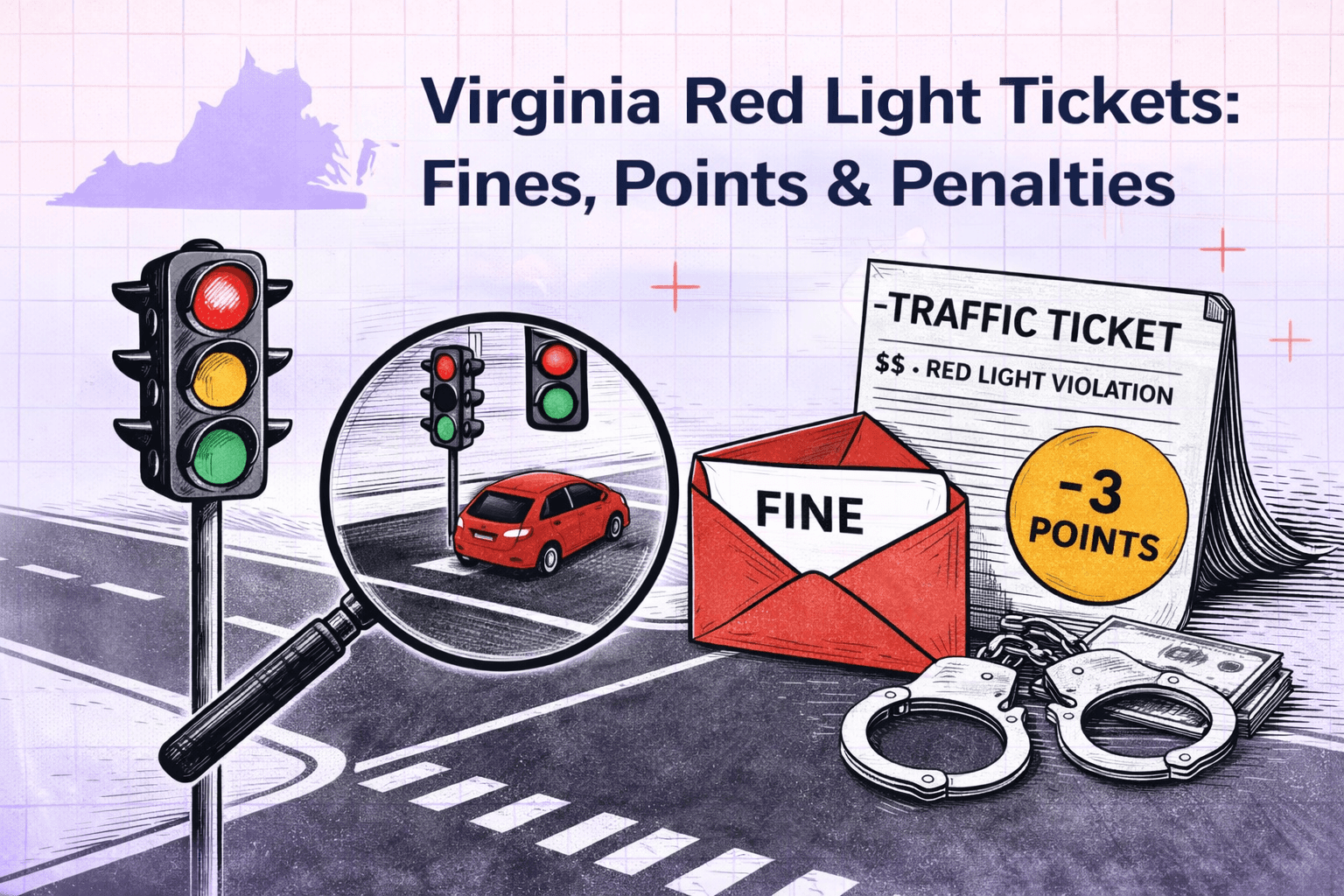
Understanding Red Light and Stop Sign Violations in Virginia
Running a red light or rolling through a stop sign might seem like a minor infraction, but in Virginia, these violations carry serious consequences. Every year, thousands of drivers receive tickets for red light and stop sign violations, and the financial and legal impacts can be substantial. Beyond the immediate fine, these violations add demerit points to your driving record, increase your insurance rates, and can affect your ability to maintain a valid driver's license.
In Virginia, traffic safety at intersections is taken seriously. Red light and stop sign violations are among the most dangerous traffic violations because they directly cause collisions. According to traffic safety data, a significant percentage of intersection crashes involve drivers who ran a red light or stop sign. Understanding the rules, penalties, and your options if you receive a ticket is essential for every Virginia driver.
Running a Red Light: Virginia Penalties
In Virginia, running a red light is a violation of Virginia Code § 46.2-833. When you run a red light—meaning you cross the stop line or enter the intersection when the signal is red—you're violating traffic law and putting yourself and others at risk.
Penalties for running a red light in Virginia include:
Demerit Points: A red light violation adds 4 demerit points to your Virginia driving record.
Fine: You can be fined between $100 and $250 for running a red light. The exact fine depends on the officer's discretion and whether you have prior violations.
Insurance Impact: Your insurance company will see the violation on your record and will likely increase your rates, sometimes by 15-25% or more.
Cumulative Effects: If you accumulate 12 or more demerit points within 12 months, your license can be suspended.
License Suspension: Serious or repeat violations can lead to license suspension, potentially for up to one year.
The financial impact of a red light violation extends far beyond the initial fine. Over a 3-year period, insurance rate increases from a single red light violation can total $500 to $1,500 or more, depending on your insurance company and driving record.
Stop Sign Violations in Virginia
A stop sign violation in Virginia occurs when you fail to come to a complete stop before the stop line or crosswalk at a stop sign. Many Virginia drivers receive tickets for "rolling stops"—slowing down but not coming to a complete stop. In Virginia traffic law, a rolling stop is still a violation.
Penalties for stop sign violations include:
Demerit Points: A stop sign violation adds 4 demerit points to your Virginia driving record, the same as a red light violation.
Fine: Stop sign violations can result in fines between $100 and $250, similar to red light violations.
Insurance Increases: Insurance companies view stop sign violations as serious infractions, and your rates will likely increase.
License Suspension Risk: Multiple stop sign violations can lead to accumulation of demerit points and eventual license suspension.
Many drivers don't realize that failing to come to a complete stop is a violation. A complete stop means your vehicle comes to a full halt, not just slowing down significantly. If you're uncertain whether you've stopped completely, you haven't stopped.
Red Light Camera Tickets in Virginia
Red light cameras have been installed at traffic intersections across Virginia, particularly in the Northern Virginia region around Washington, D.C., and in other urban areas. These automated cameras capture images of vehicles running red lights and issue citations to the vehicle's registered owner.
Cities with red light cameras in Virginia include:
Arlington County
Alexandria
Falls Church
Fairfax City
Several other Northern Virginia municipalities
Important considerations about red light camera tickets:
Registered Owner Liability: The citation goes to the vehicle's registered owner, not necessarily the driver. This means if someone else was driving your vehicle, you may still receive the ticket.
Civil vs. Criminal: Red light camera citations are often treated as civil violations rather than criminal traffic violations, though this varies by jurisdiction.
Demerit Points: Red light camera tickets may or may not add demerit points to your driving record, depending on how your city or county handles them.
Fines: Red light camera fines are typically $100-$150, lower than officer-issued citations.
No Traffic Court: Many red light camera tickets don't require a court appearance; you can pay the fine by mail or online.
Right to Contest: You typically have the right to contest a red light camera ticket and request evidence (photos and video).
How to Determine If Your Violation Was at a Red Light Camera Location
If you receive a citation for running a red light, check whether it was issued by a red light camera or a traffic officer. The citation will typically indicate this. Red light camera citations often have less detailed information about the violation and may include photos of your vehicle at the intersection.
If you're unsure which intersections in your city have red light cameras, contact your local police department or city traffic authority. They can provide a list of camera-equipped intersections.
Fighting a Red Light Ticket in Virginia
If you believe you received a red light ticket unfairly, you have the right to contest it. Here are your options:
Request a Hearing: You can request a traffic court hearing to challenge the ticket. This gives you the opportunity to present your side of the story.
Review Evidence: You can request the evidence against you, including photos or video (for camera citations) or the officer's dashcam footage (for officer-issued citations).
Challenge the Officer's Observation: You can question whether the officer actually saw the violation or whether their interpretation was correct. For example, you might argue that the light changed while you were in the intersection.
Technical Defenses: For red light camera tickets, you can argue technical issues, such as inadequate yellow light duration or faulty camera calibration.
Hire an Attorney: Some Virginia drivers hire traffic attorneys to represent them in traffic court. An attorney can review the evidence and present legal arguments on your behalf.
Important note: Virginia traffic courts are strict about procedure and evidence. If you decide to fight a ticket, understand the rules and be prepared to present clear arguments based on the evidence.
The Difference Between Running a Red Light and Entering During Yellow
A common question is whether entering an intersection during a yellow light is a violation. In Virginia, a yellow light means the signal is about to turn red, and you should prepare to stop. However, if you enter the intersection safely on a yellow light, it's not a violation. The violation occurs when you enter after the light has turned red.
The challenge is that the moment the light changes from yellow to red is instantaneous. If you're in the intersection when it turns red, you're not necessarily in violation, especially if you couldn't stop safely. However, if you accelerate to "beat" a red light, or enter the intersection clearly after the light has turned red, you're in violation.
Insurance Impact of Red Light and Stop Sign Violations
Insurance companies take red light and stop sign violations very seriously. These violations indicate risky driving behavior and increase the likelihood of accidents. When you receive a violation:
Rate Increases: Your insurance rates will increase, often by 15-25% or more for a 3-year period.
Renewal Impact: The violation will affect your insurance rates at each renewal for typically 3-5 years.
Policy Cancellation: Multiple violations might result in your insurance company canceling your policy.
Shopping for New Insurance: After a violation, other insurance companies may charge you higher rates or decline to insure you.
For many drivers, the insurance rate increases are more costly than the initial fine and demerit points combined.
Can a Driver Improvement Course Help?
If you've received a red light or stop sign ticket, you may be wondering if taking a driver improvement course can help. The answer depends on several factors:
Court Discretion: Some Virginia courts allow drivers to take a driver improvement course in exchange for ticket dismissal or point reduction. However, this is not guaranteed and depends on the judge and the specific circumstances.
Insurance Discount: Many insurance companies offer a discount (typically 5-10%) if you complete an approved driver improvement course. This discount can help offset the increased rates from a violation.
Record Improvement: Completing a course demonstrates to the court and insurance company that you're committed to safe driving, which can be viewed favorably in some circumstances.
Future Violations: Taking a course can help you avoid future violations by improving your understanding of traffic safety rules.
It's worth noting that completing a driver improvement course will not remove points from your record or dismiss the ticket on its own. However, a course can provide supplementary benefit in some situations.
Preventing Red Light and Stop Sign Violations
The best approach is to prevent violations in the first place. Here are safe driving practices:
Stop Completely: At every stop sign, bring your vehicle to a complete stop. Your vehicle should not be rolling.
Plan for Red Lights: When approaching a traffic light, start slowing down as you near the intersection, especially if the light has been green for a while (it may be about to change).
Avoid Acceleration on Yellow: If you see a yellow light, don't accelerate to "beat" it. Slow down and prepare to stop.
Be Extra Careful in Unfamiliar Areas: When driving in an area you don't know, be more cautious at intersections and pay close attention to traffic signals.
Minimize Distractions: Distracted driving can cause you to miss red lights. Keep your focus on the road.
Respect Pedestrians: Even if you have a green light, check for pedestrians before proceeding. Failure to yield to pedestrians is another serious violation.
Summary of Penalties
To recap, here are the main penalties for red light and stop sign violations in Virginia:
4 demerit points
Fine of $100-$250
Insurance rate increases of 15-25% for 3-5 years
Potential license suspension if you accumulate 12+ demerit points in 12 months
Take Action: Enroll in ABC Driving Improvement Today
If you want to improve your understanding of Virginia traffic laws and avoid violations like running red lights or rolling through stop signs, ABC Driving Improvement offers a comprehensive 8-hour online driver improvement course for just $74.99. Our Virginia DMV-approved course covers defensive driving, intersection safety, and all the traffic rules you need to know to drive safely in Virginia.
Whether you've received a ticket and want to improve your driving, or you simply want to refresh your knowledge of traffic safety, our course is convenient, affordable, and 100% online. Enroll today at abcdrivingcourse.com and take control of your driving safety and insurance costs.
Conclusion
Red light and stop sign violations are serious infractions in Virginia with consequences that extend far beyond the initial fine. The demerit points, insurance rate increases, and potential license suspension make these violations costly and stressful. By understanding Virginia's traffic laws, practicing safe driving habits, and considering a driver improvement course to reinforce your knowledge, you can protect yourself, your vehicle, and others on the road.
Dismiss Your Ticket Online
Virginia DMV-approved 8-hour driver improvement clinic. Complete at your own pace from any device.
Start Course — $74.99Why Choose ABC Driving Improvement?
Official Virginia clinic
Complete at your own pace, 24/7
Virginia drivers served
Based on verified reviews
Which Course Code Do You Need?
Check your court paperwork or DMV letter for your assigned code.
Get Your Certificate