Virginia RADEP Program: The 12-Hour Reckless Driver Course
Get Your CertificateLearn about Virginia's RADEP program: 12-hour requirements, topics covered, costs, and how it differs from 8-hour courses.
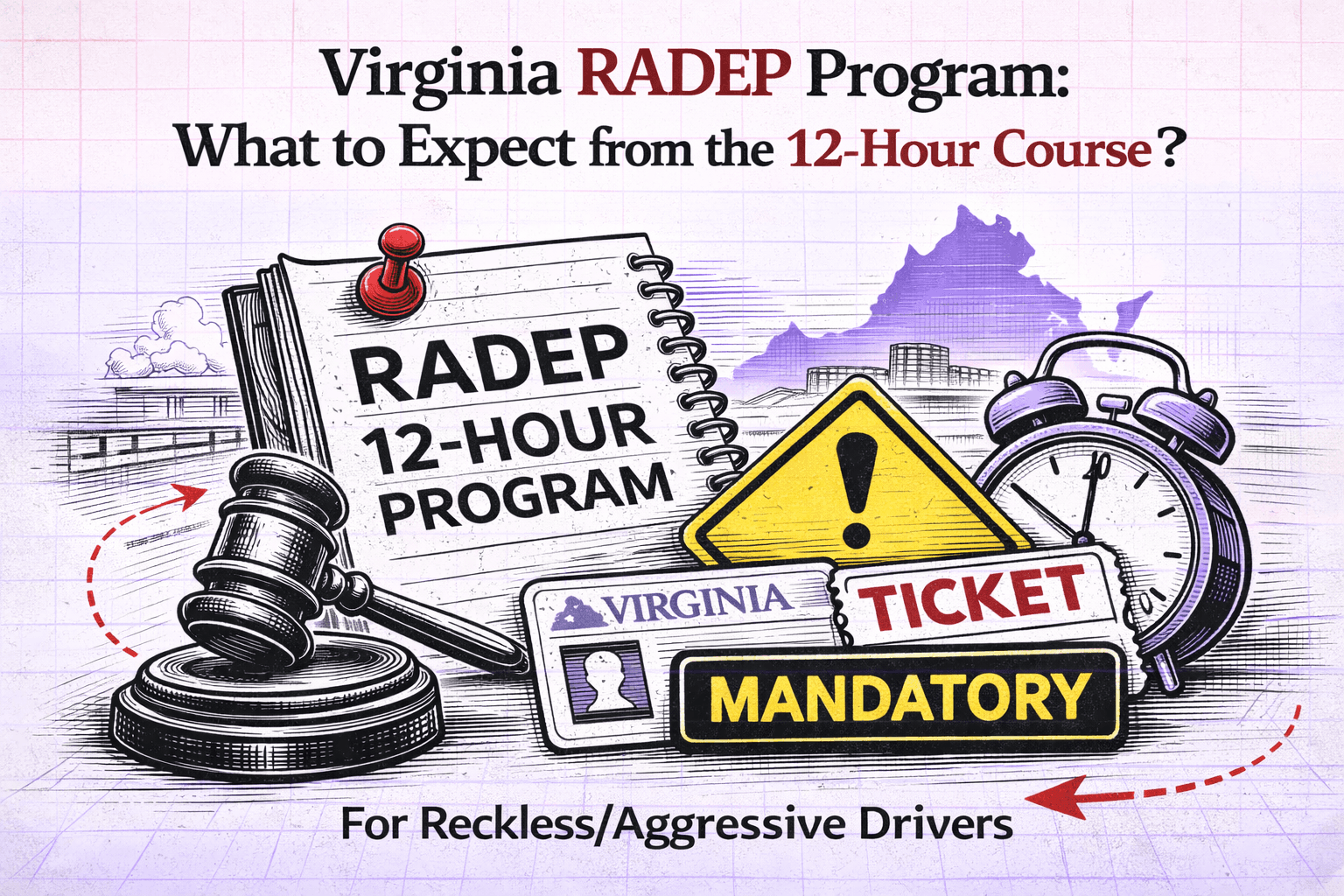
Understanding Virginia's RADEP Program
If you've been convicted of reckless or aggressive driving in Virginia, you may be required to complete the RADEP program as part of your sentencing. RADEP stands for Reckless/Aggressive Driver Education Program, and it's a specialized 12-hour educational requirement designed specifically for drivers who've committed serious moving violations. This comprehensive guide explains what RADEP is, who must take it, what to expect from the course, how it differs from standard driver improvement courses, and how completing it successfully can benefit your driving record and insurance rates.
What Is RADEP? Breaking Down the Acronym
RADEP stands for Reckless/Aggressive Driver Education Program. It's a court-ordered educational intervention for drivers convicted of reckless driving, aggressive driving, or related serious violations in Virginia.
The program was created based on research showing that educational intervention can effectively modify driver behavior, reduce future violations, and improve road safety. Unlike typical driver improvement courses that provide general traffic law education and defensive driving techniques, RADEP is specifically tailored to address the dangerous behaviors and attitudes that led to reckless or aggressive driving convictions.
Who Must Complete the RADEP Program?
Virginia courts order drivers to complete RADEP as part of sentencing for specific violations. You'll be required to complete RADEP if you've been convicted of:
Reckless driving: Any reckless driving conviction, regardless of whether an accident occurred
Aggressive driving: Conviction for aggressive driving under Virginia Code 46.2-862
Racing: Street racing or unauthorized racing convictions
Speed-related reckless: Reckless driving based on excessive speed (typically 20+ mph over the limit)
Serious moving violations with reckless elements: Other convictions where the court determines RADEP is appropriate
The specific requirement—whether RADEP, a standard driver improvement course, or another program—is determined by the judge at sentencing. Some judges make RADEP a condition of your sentence, while others may leave it optional. However, many insurance companies and certain employment situations may require RADEP completion regardless of court orders.
RADEP vs. Standard 8-Hour Driver Improvement Courses: Key Differences
While both RADEP and standard driver improvement courses are educational programs for drivers with violations, there are significant differences in scope, focus, and requirements.
Duration:
RADEP: 12 hours of instruction
Standard driver improvement: 8 hours of instruction
Focus and Content:
RADEP: Specifically addresses reckless and aggressive driving behaviors, the psychology behind dangerous driving, impulse control, consequence awareness, and behavioral change strategies
Standard driver improvement: Covers general Virginia traffic laws, basic defensive driving techniques, and general safety principles
Target Audience:
RADEP: Drivers convicted of reckless or aggressive driving (high-risk drivers)
Standard driver improvement: Drivers with various violations or those seeking to reduce insurance rates or points
Behavioral Component:
RADEP: Includes significant focus on anger management, impulse control, risk awareness, and attitude change
Standard driver improvement: Focuses primarily on traffic laws and driving techniques
Court Recognition:
RADEP: Recognized as fulfilling court-ordered RADEP requirements; shows serious engagement with behavior change
Standard driver improvement: Cannot fulfill RADEP requirements (you must take actual RADEP if it's court-ordered)
Cost:
RADEP: Typically $150-$300 for the 12-hour program
Standard driver improvement: Typically $75-$150 for the 8-hour program
What Topics Are Covered in RADEP?
The RADEP program covers a comprehensive curriculum specifically designed to address reckless and aggressive driving behaviors. While the exact curriculum may vary slightly depending on the provider, most RADEP courses cover:
Module 1: Understanding Reckless and Aggressive Driving
Legal definitions of reckless and aggressive driving in Virginia
How reckless/aggressive driving differs from other traffic violations
Statistics on accidents, injuries, and deaths caused by reckless driving
Long-term consequences of reckless driving convictions
Module 2: Driving Attitudes and Risk Perception
How attitudes influence driving behavior
Assessing your personal driving risk factors
Recognizing overconfidence and overestimation of driving skills
Understanding risk perception and consequence awareness
Module 3: Anger and Impulse Control
The psychology of road rage and aggressive responses to driving triggers
Recognizing anger escalation patterns
Emotion regulation techniques and coping strategies
De-escalation and conflict avoidance on the road
Module 4: Decision-Making and Consequences
How impulsive decision-making leads to reckless driving
Evaluating consequences before acting
Cost-benefit analysis of risky driving decisions
Legal, financial, personal, and safety consequences of reckless driving
Module 5: Defensive Driving and Hazard Recognition
Identifying driving hazards and risks
Defensive driving techniques specific to high-risk situations
Safe following distances, speed management, and lane positioning
Managing distractions and staying focused
Module 6: Traffic Laws and Regulations
Virginia traffic laws relevant to reckless/aggressive driving (speed limits, move-over law, etc.)
Understanding penalties for various driving violations
License suspension, points, and other consequences
Module 7: Behavior Change and Commitment
Developing a personal behavior change plan
Identifying triggers and developing alternative responses
Committing to safer driving habits
Resources and support for maintaining behavior change
Module 8: Real-World Case Studies and Scenarios
Analysis of reckless driving accidents and their consequences
Video examples of dangerous driving situations
Decision-making exercises and scenario-based learning
Course Format and Delivery Options
RADEP courses can be delivered in different formats:
In-Person Classroom: Some providers offer traditional classroom settings where instruction is delivered in person. This format allows for direct interaction with instructors and group discussions.
Online Format: Many RADEP providers now offer online courses that allow participants to complete instruction on their own schedule from any location. Online courses typically include:
Video-based instruction modules
Interactive quizzes and exercises
Self-assessment tools
Printable certificates of completion
Flexible scheduling (though a deadline for completion applies)
Hybrid Format: Some providers combine online instruction with periodic in-person discussions or assessments.
Check with your RADEP provider about format options and whether they're Virginia-approved for your specific situation.
Completion Requirements and Certification
To successfully complete RADEP, you must:
Complete all course modules: You must finish all 12 hours of instruction. If a course is court-ordered, you cannot skip modules.
Attend or participate fully: For in-person courses, attendance is tracked. For online courses, completion of each module is verified.
Complete all assignments and assessments: Most RADEP courses include quizzes, written reflections, or other assignments that must be completed
Pass any required assessments: You typically must achieve a passing score on quizzes and assessments (usually 70% or higher)
Complete within the specified timeframe: Courts typically set a deadline for completion (often 60-90 days from the court order)
Obtain a certificate of completion: Upon successful completion, you receive a certificate that must be provided to the court
Failure to complete RADEP by the court-ordered deadline can result in contempt of court charges, additional fines, or extension of license suspension.
Cost and Timeline
Costs:
Course tuition: $150-$300 for the 12-hour RADEP program
Additional expenses: Some courts require payment of court costs and fees in addition to RADEP tuition
Timeline:
Court order to completion: Typically 60-90 days, though courts may grant extensions
Course duration: Online courses can be completed in as little as one week if taken full-time, but most participants complete over 2-3 weeks
Certificate processing: Certificates are typically issued upon completion or within a few days
It's important to start RADEP promptly after receiving your court order rather than waiting until near the deadline, as this gives you flexibility if issues arise.
How RADEP Completion Affects Your Driving Record and Insurance
Completing RADEP won't erase a reckless or aggressive driving conviction from your record, but it can have several positive effects:
Legal Benefits:
Demonstrates to the court that you're taking your offense seriously
May support requests for record expungement (removing the conviction) in certain circumstances after a waiting period
Shows compliance with court orders, which is important if you're on probation or face additional hearings
Insurance Benefits:
Many insurance companies offer modest discounts (typically 5-10%) for completing an approved driver improvement course
Demonstrates to insurers that you're committed to safe driving, which may result in less severe rate increases
Can help when seeking new insurance after a reckless driving conviction
Personal Benefits:
Provides education and tools for changing dangerous driving behaviors
May reduce your risk of future violations and accidents
Supports personal growth and accountability
Important Considerations for RADEP Participants
Only Approved Providers: You must complete RADEP through a Virginia-approved provider. Ensure your chosen course provider is specifically approved for RADEP before enrolling. Using an unapproved provider could result in your completion not being recognized by the court.
Court Deadline Compliance: If your RADEP enrollment is court-ordered, missing the deadline can result in serious consequences including contempt of court charges. Mark your deadline clearly and plan to complete well before that date.
Documentation: Keep your completion certificate and receipt of enrollment. You'll need to provide proof of completion to the court, and you may need it for your insurance company as well.
Cannot Substitute Standard Courses: If you're court-ordered to complete RADEP, you cannot substitute a standard 8-hour driver improvement course. RADEP specifically is required.
The Role of RADEP in Long-Term Behavior Change
While RADEP is an educational program rather than a therapeutic intervention, research suggests that structured education about the consequences of reckless driving and techniques for behavior change can be effective in reducing future violations.
The key to success is approaching RADEP not as a checkbox to satisfy a court order, but as a genuine opportunity to reflect on your driving behavior, understand what led to your conviction, and commit to safer driving practices going forward.
Many drivers who initially view RADEP as a burden find value in the program's emphasis on recognizing triggers, managing impulses, and developing alternative responses to high-stress driving situations.
Conclusion: Taking Responsibility and Moving Forward
A reckless or aggressive driving conviction is serious, and RADEP is designed as both an accountability measure and an educational opportunity. While the 12-hour commitment and costs are significant, completing RADEP demonstrates to the court, your insurance company, and yourself that you're serious about changing dangerous driving behaviors.
If you've been ordered to complete RADEP or are considering the program to strengthen your position in court or with your insurance company, enroll in an approved provider today. Ensure you choose a Virginia-approved RADEP provider and allow sufficient time to complete the program before any court deadline.
Additionally, consider complementing your RADEP completion with ABC Driving Improvement's Virginia DMV-approved 8-hour driver improvement course ($74.99). While it doesn't substitute for RADEP, this course provides additional perspective on Virginia traffic laws and defensive driving techniques that reinforce the behavior change message. Visit abcdrivingcourse.com to learn more about how both programs can support your path toward safer, more responsible driving in Virginia.
Dismiss Your Ticket Online
Virginia DMV-approved 8-hour driver improvement clinic. Complete at your own pace from any device.
Start Course — $74.99Why Choose ABC Driving Improvement?
Official Virginia clinic
Complete at your own pace, 24/7
Virginia drivers served
Based on verified reviews
Which Course Code Do You Need?
Check your court paperwork or DMV letter for your assigned code.
Get Your Certificate