Virginia No-Passing Zone Ticket: Fines, Points & Next Steps
Get Your CertificateGot a no-passing zone ticket in Virginia? Learn the fines, demerit points, and how a driver improvement course can help your record.
What Is a No-Passing Zone in Virginia?
No-passing zones are sections of road where overtaking another vehicle is prohibited because sight distance is too limited for a safe pass. In Virginia, these zones are marked by a solid yellow line on your side of the centerline — commonly seen on winding two-lane roads, approaching hills, curves, and near intersections. When you see that solid yellow line, it's the law's way of saying: do not pass here, no matter how slowly the vehicle ahead is moving.
Virginia Code § 46.2-841 makes it unlawful to overtake or pass another vehicle in a no-passing zone. The prohibition is absolute — unlike some traffic rules that allow judgment calls, this one does not. If you cross the centerline to pass while a solid yellow line runs along your side of the road, you have committed a traffic violation.
Fines and Demerit Points for a No-Passing Zone Ticket
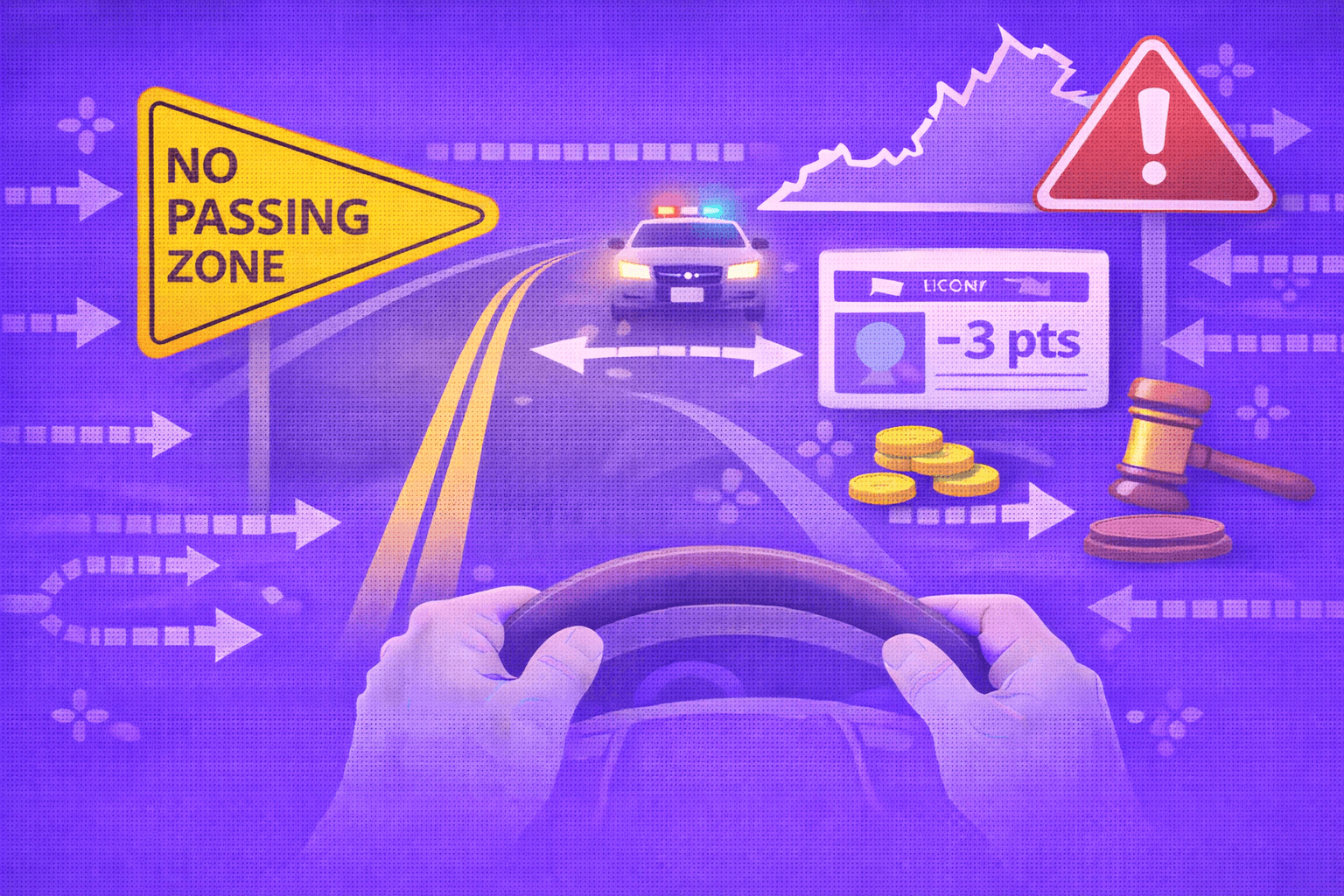
A no-passing zone violation in Virginia is a traffic infraction that typically carries a fine and demerit points on your driving record. The fine can range from approximately $30 to $100, depending on the jurisdiction, and the violation is assessed 3 demerit points on your Virginia driving record under the DMV's point system.
Those 3 demerit points remain on your record for two years from the date of the offense. If you accumulate enough points within a short period — 8 points in 12 months or 12 points in 24 months — the Virginia DMV will require you to enroll in a driver improvement clinic. Reaching 18 points in 12 months can result in license suspension. To understand how the full system works, see our guide to the Virginia demerit points system.
Three demerit points may sound small, but combined with other violations or moving violations from the same period, they can push your total dangerously close to the DMV's mandatory action thresholds.
When Can Passing Be Legal Even with a Solid Yellow Line?
There are a few narrow exceptions where passing in a no-passing zone may be legally permitted in Virginia. Specifically, Virginia law allows a driver to pass a stationary vehicle, a bicycle, a moped, or a pedestrian traveling in the same direction, even in a no-passing zone — provided the driver can do so safely and without obstructing oncoming traffic. This exception reflects the reality that slow-moving non-motorized users sometimes make passing necessary even on roads with limited sight distance.
However, this exception does not apply to passing another motor vehicle traveling at a slow speed. If you're stuck behind a car driving 25 mph in a 55 mph zone and you're approaching a solid yellow centerline, you must wait. Patience is legally required.
How a No-Passing Ticket Affects Your Insurance
Beyond the immediate fine and demerit points, a no-passing zone violation can affect your car insurance rates. Virginia insurers have access to your driving record, and any moving violation — including a no-passing ticket — can be used to justify a rate increase at your next policy renewal. The impact of Virginia traffic tickets on your insurance rates can last for years, making even a single infraction surprisingly expensive over time.
One of the most effective ways to limit this damage is to take action quickly. Enrolling in a Virginia DMV-approved driver improvement course can earn you positive safe driving points, which partially offset the demerit points on your record. Some insurance carriers also offer discounts to drivers who complete approved courses — so the course can actually save you money on two fronts.
What to Do After Getting a No-Passing Zone Ticket
Here's a practical action plan if you've received a no-passing zone citation in Virginia:
Read the ticket carefully. Check the court date and the specific statute cited. Make sure the fine amount is correct and that you understand your options (pay, contest, or prepay).
Decide whether to contest or pay. If you believe the ticket was issued in error — for example, if you were passing a bicycle rather than a motor vehicle — you may have grounds to contest it in traffic court. Review our guide on how to get a Virginia traffic ticket dismissed for more detail.
Check your current driving record. Before deciding how to respond, it helps to know where your record stands. Learn how to check your Virginia driving record online.
Enroll in a driver improvement course. Even if you pay the fine without contesting, completing the course proactively earns you 5 safe driving points — a meaningful buffer if future violations occur.
Consider the insurance impact. Let your insurer know you've completed a driver improvement course, as this may limit or prevent a rate increase.
Why No-Passing Zones Exist
No-passing zones are placed strategically by traffic engineers based on visibility distance standards. The core issue is simple: if you can't see far enough ahead, you can't safely judge whether there's time to pass before an oncoming vehicle arrives. Roads with hills, sharp curves, or limited clear zones present genuine hazards for passing maneuvers.
Data consistently shows that head-on collisions — which often result from unsafe passing attempts — carry extremely high fatality rates. No-passing zone markings exist precisely because engineers have determined that sight lines at those points are insufficient for safe overtaking. Respecting these markings isn't just about avoiding a ticket; it's about avoiding a potentially fatal collision.
Frequently Asked Questions
How long do no-passing zone demerit points stay on my Virginia record?
Demerit points from a no-passing zone violation remain on your Virginia driving record for two years from the date of the offense. The conviction itself remains visible on your full record for longer — typically three to five years — but only affects your point balance for two years.
Can I take a driver improvement course to avoid points from a no-passing ticket?
Completing a Virginia DMV-approved driver improvement course does not remove demerit points already assessed for a conviction. However, it adds 5 positive safe driving points to your balance, which effectively neutralizes the 3 demerit points from the violation. This is why enrollment is so beneficial after any moving violation.
What if I was passing a cyclist in a no-passing zone — is that still a violation?
Virginia Code provides an exception allowing drivers to pass bicycles and mopeds in no-passing zones when it can be done safely without obstructing oncoming traffic. However, the burden is on the driver to demonstrate the pass was safe. If a police officer observed the maneuver and issued a citation, you may need to contest the ticket in court and present evidence that you were passing a bicycle, not a motor vehicle.
Protect Your Driving Record Today
A no-passing zone ticket doesn't have to derail your clean driving record. ABC Driving Improvement's 8-hour online driver improvement course is fully approved by the Virginia DMV, can be completed at your own pace from any device, and earns you 5 positive safe driving points. Enroll now for just $74.99 and start turning your record in the right direction. Visit our driver resources page for more helpful guides on navigating Virginia traffic law.
Dismiss Your Ticket Online
Virginia DMV-approved 8-hour driver improvement clinic. Complete at your own pace from any device.
Start Course — $74.99Why Choose ABC Driving Improvement?
Official Virginia clinic
Complete at your own pace, 24/7
Virginia drivers served
Based on verified reviews
A no-passing zone violation in Virginia carries demerit points and a fine — but completing a DMV-approved driver improvement course is one of the best ways to protect your record.
Which Course Code Do You Need?
Check your court paperwork or DMV letter for your assigned code.
Get Your Certificate