Virginia Hands-Free Driving Law: Penalties & Requirements
Get Your CertificateLearn Virginia's hands-free driving law, when it took effect, penalties for violations, and exceptions. Understand how distracted driving impacts safety.
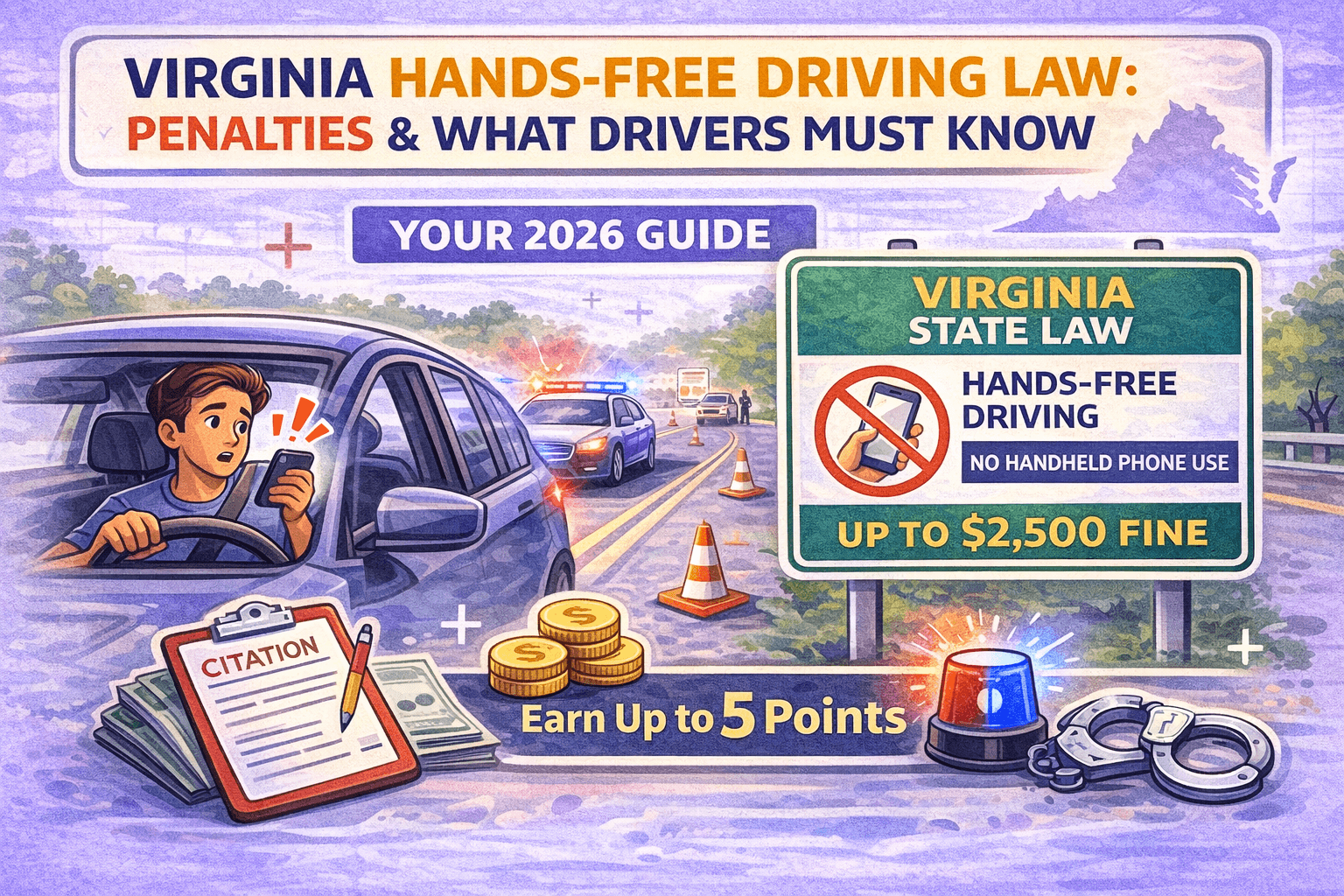
Understanding Virginia's Hands-Free Driving Law
Virginia's hands-free driving law represents a significant shift in how the state approaches distracted driving safety. Enacted to protect drivers and pedestrians from the dangers of cell phone use while operating a vehicle, this law reflects growing national concerns about accidents caused by distracted driving. If you drive in Virginia or frequently travel through the state, understanding this law is essential to avoiding costly violations and, more importantly, staying safe on the road.
When Did Virginia's Hands-Free Law Take Effect?
Virginia's hands-free driving law became effective on January 1, 2021. This law fundamentally changed how drivers can interact with their phones while operating a vehicle. The legislation was designed to reduce the number of accidents caused by distracted driving, which has become an increasingly serious problem across the United States.
Prior to this law, Virginia had restrictions on texting while driving, but the hands-free law expanded protections by addressing broader phone use. The law specifically prohibits drivers from holding or physically manipulating a mobile phone while the vehicle is in motion.
What Exactly Does the Hands-Free Law Prohibit?
Under Virginia Code Section 46.2-818.4, it is illegal for any driver to hold a mobile phone or physically manipulate the device while operating a vehicle on any public road. The law is comprehensive and covers:
Holding the phone in your hand while driving
Texting or composing messages while the vehicle is moving
Reading messages or emails on your phone
Watching videos or browsing on your phone while driving
Physically touching or swiping your phone screen to operate it
Holding the phone to your ear to make or receive calls
The law applies to all drivers, regardless of age, and covers all types of mobile phones, including smartphones and similar handheld devices.
Legal Exceptions to the Hands-Free Law
While the law is strict, there are specific exceptions where drivers can use their phones:
Emergency calls: Drivers can hold their phone to call 911 or report a safety hazard in an emergency situation
Hands-free devices: Using a phone mounted on the dashboard or held by a hands-free mount is permitted
Voice commands: Operating your phone using voice-activated features without physically touching it is allowed
GPS navigation: Using voice-activated GPS or briefly glancing at a mounted GPS device is permitted (though extended glancing could still result in distracted driving charges)
Parked vehicles: If your vehicle is parked and not in motion, you can use your phone normally
Emergency responders: Police officers, firefighters, and other emergency personnel are exempt while performing their official duties
Penalties for Violating Virginia's Hands-Free Law
Violations of Virginia's hands-free driving law carry significant penalties designed to deter drivers from engaging in this risky behavior:
First offense: Fines up to $125 and one demerit point
Second or subsequent offense within 12 months: Fines up to $175 and two demerit points
If a violation occurs in a school zone: Fines are doubled to up to $250 for a second offense
While these fines might seem moderate compared to other traffic violations, the demerit points can have long-term consequences on your driving record and insurance rates. Additionally, if a hands-free violation contributes to an accident, you could face additional charges and penalties.
How Hands-Free Violations Differ from Other Traffic Violations
Unlike some traffic violations that result in points only if you cause an accident, hands-free violations result in demerit points regardless of whether an accident occurs. This is because the law is designed to prevent accidents before they happen by eliminating the distraction entirely.
However, if a hands-free violation leads to reckless driving, improper driving, or causes an accident, the penalties can escalate dramatically. For example, reckless driving charges can result in fines up to $2,500, license suspension, and even jail time.
The Connection Between Distracted Driving and Safety Statistics
Virginia implemented the hands-free driving law based on compelling national safety data. According to the National Highway Traffic Safety Administration (NHTSA), distracted driving causes thousands of deaths and hundreds of thousands of injuries annually in the United States.
Research shows that:
Texting while driving increases the risk of a crash by 23 times
Talking on a phone while driving impairs reaction time similarly to driving with a blood alcohol level of 0.08%
Drivers using cell phones are four times more likely to be in a crash
Young drivers are particularly vulnerable to distracted driving risks
Virginia's hands-free law directly addresses these risks. By prohibiting drivers from holding their phones, the state aims to reduce distraction-related accidents and save lives on Virginia roads.
Why You Should Care Even If You Haven't Been Cited
Many drivers might assume they're careful enough that a hands-free violation won't happen to them. However, even brief moments of distraction—glancing at a notification or reaching for your phone—can have catastrophic consequences. The law exists to protect not just you, but everyone sharing the road, including pedestrians and passengers.
Beyond legal compliance, understanding and following the hands-free law is about making a conscious choice to drive safely. This mindset is what defensive driving education emphasizes.
How Driver Improvement Courses Help Address Distracted Driving
If you've received a hands-free violation or simply want to improve your driving habits, a comprehensive driver improvement course can be incredibly valuable. ABC Driving Improvement offers a Virginia DMV-approved 8-hour online driver improvement course for just $74.99 that covers the latest traffic laws, including Virginia's hands-free regulations, and emphasizes the dangers of distracted driving.
Completing an accredited driver improvement course can:
Help you avoid or reduce insurance rate increases after a violation
Provide a deeper understanding of why hands-free laws exist and how to follow them
Potentially allow you to request point reduction (up to 5 points) from the court in certain cases
Educate you on the psychology of distracted driving and safe alternatives
Improve your overall defensive driving skills
The course is 100% online, meaning you can complete it on your own schedule from anywhere in Virginia.
Practical Tips for Complying with the Hands-Free Law
Following Virginia's hands-free driving law is straightforward with a few simple practices:
Use a phone mount: Keep your phone secured in a dashboard or windshield mount for GPS navigation
Enable voice assistants: Use Siri, Google Assistant, or similar voice controls for calls and messages
Put your phone away: Place it in your glove compartment, under the seat, or in your bag while driving
Plan ahead: Enter your GPS destination before you start driving
Let calls go to voicemail: Answer calls only when safely pulled over
Turn off notifications: Disable visual and audio alerts that might tempt you to check your phone
Set a good example: If you drive with passengers, especially young people, model hands-free driving behavior
The Bigger Picture: Building a Culture of Safe Driving
Virginia's hands-free driving law is part of a broader national movement to reduce distracted driving. States across the country have implemented similar measures, recognizing that driver behavior change requires both legal enforcement and cultural shift.
As more drivers comply with these laws and understand their importance, we move closer to roads where distraction-related accidents become increasingly rare. Your decision to follow the hands-free law and encourage others to do the same contributes to this positive change.
Conclusion: Stay Safe and Compliant
Virginia's hands-free driving law is clear, straightforward, and designed to save lives. Understanding the requirements, penalties, and exceptions ensures you can drive legally and safely. Whether you're a long-time Virginia resident or new to the state, making hands-free driving a habit is one of the most effective ways to reduce accident risk.
If you're looking to deepen your knowledge of Virginia traffic laws and defensive driving techniques, ABC Driving Improvement's approved 8-hour course provides comprehensive coverage of these topics and more. For just $74.99, you'll gain the knowledge to drive safer and comply with all Virginia traffic laws. The course is entirely online, fits your schedule, and provides certification upon completion.
Enroll today at abcdrivingcourse.com and take control of your driving safety.
Dismiss Your Ticket Online
Virginia DMV-approved 8-hour driver improvement clinic. Complete at your own pace from any device.
Start Course — $74.99Why Choose ABC Driving Improvement?
Official Virginia clinic
Complete at your own pace, 24/7
Virginia drivers served
Based on verified reviews
Which Course Code Do You Need?
Check your court paperwork or DMV letter for your assigned code.
Get Your Certificate