Virginia DMV Administrative Hearing: What to Expect
Get Your CertificateComprehensive guide to Virginia DMV administrative hearings, process, outcomes, and how to prepare for your hearing.
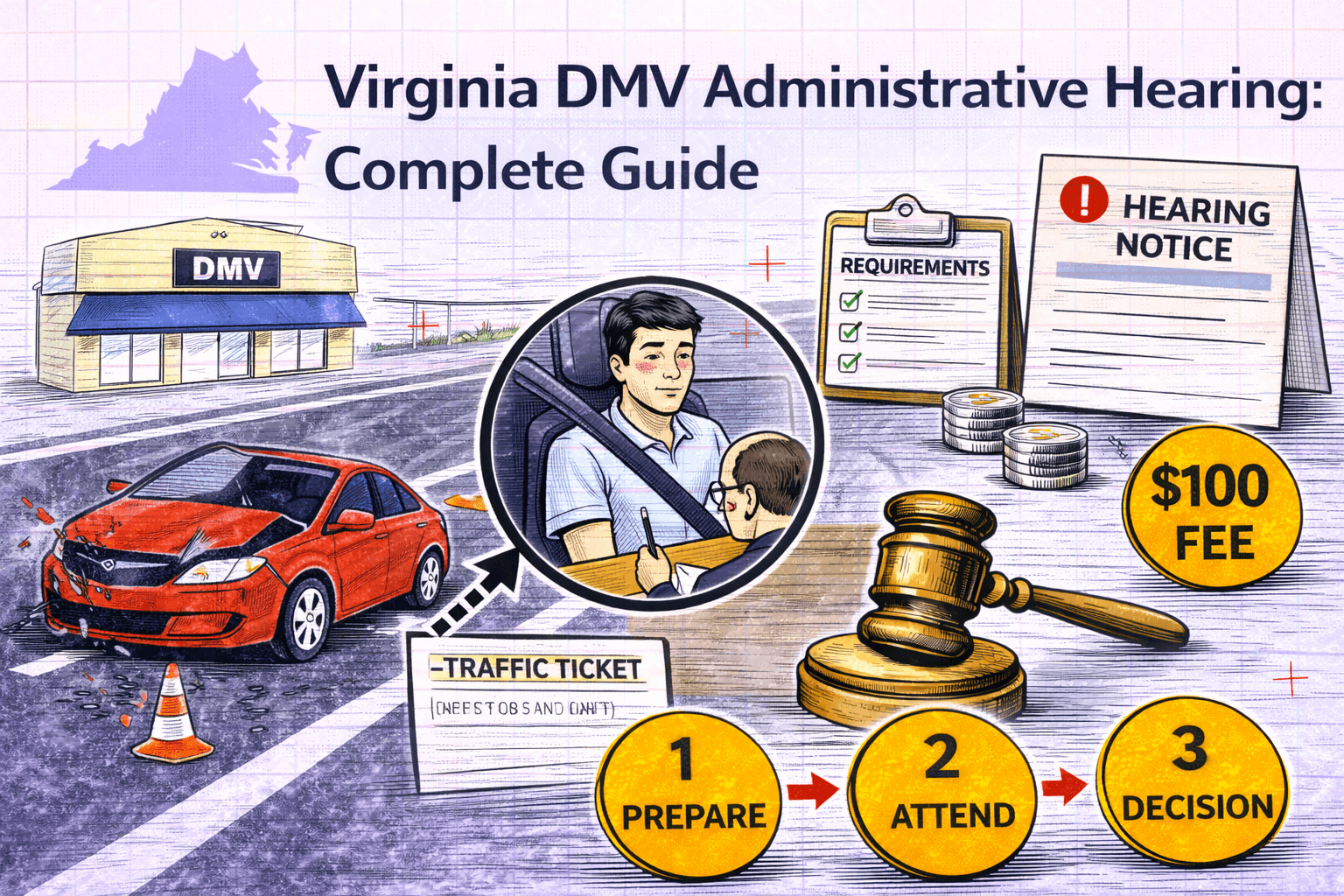
Understanding DMV Administrative Hearings
A Virginia DMV administrative hearing can determine whether you maintain your driving privileges or lose your license for months or even years. Unlike a traffic court appearance where you fight a specific ticket, an administrative hearing focuses on broader licensing issues—whether you should be allowed to hold a license at all. Understanding the process, your rights, and how to prepare is essential to achieving the best possible outcome.
Administrative hearings are civil proceedings, not criminal, but they carry serious consequences for your ability to drive. Taking them seriously and preparing thoroughly significantly improves your chances of a favorable outcome.
What Triggers a Virginia DMV Administrative Hearing
Habitual Offender Status
One of the most common reasons for an administrative hearing is being declared a "habitual offender" by Virginia courts. You can be declared a habitual offender if, within a 10-year period, you accumulate:
Three or more reckless driving convictions, OR
Four or more traffic violations (including speeding, improper passing, etc.), OR
A combination of three or more violations including at least one reckless driving
Once declared a habitual offender, your license is automatically suspended. The DMV hearing allows you to contest this status or request reinstatement after the mandatory suspension period.
Medical Review Issues
The DMV may request a medical review hearing if:
You failed a vision test
You failed a physical examination required for license renewal
The DMV received a medical report suggesting you're not fit to drive (from law enforcement, medical professionals, or others)
You failed to respond to a medical review request or failed to provide required medical documentation
Medical review hearings determine whether your health condition allows you to safely operate a motor vehicle.
Excess Demerit Points
If you accumulate too many points within the specified timeframe, the DMV schedules a hearing:
12 points in 12 months
18 points in 24 months
24 points in 36 months
At the hearing, you can explain the circumstances of your violations and may present evidence of defensive driving courses or other mitigating factors.
Underage DUI Conviction
Drivers under 21 convicted of DUI or any alcohol-related driving offense are required to have an administrative hearing before any license reinstatement is considered. These hearings specifically address substance abuse issues.
Failure to Pay Child Support or Court Fines
If you're delinquent on child support or have outstanding court-ordered fines, the court may request a DMV hearing to determine whether suspension is appropriate and whether you can address the obligation.
Failure to Provide Required Documentation
If the DMV requests documentation (such as proof of insurance, medical records, or other required documents) and you fail to provide it, they may schedule a hearing to determine whether your license should be suspended for non-compliance.
How the DMV Administrative Hearing Process Works
The Notice of Hearing
You'll receive a Notice of Hearing by mail from the Virginia DMV. This notice includes:
The date, time, and location of your hearing
The specific reason(s) for the hearing
Your rights in the proceeding
Contact information for the DMV hearing office
Instructions for rescheduling if needed
It's critical that you acknowledge receipt of this notice and mark your calendar. Missing a hearing can result in immediate license suspension without further notice.
Where Hearings Take Place
Virginia has multiple hearing locations throughout the state, including:
DMV regional offices in major cities
Some hearings are conducted by telephone
Certain hearings may be held via videoconference
Your notice will specify the hearing location and format. If the assigned location is inconvenient, contact the DMV to request an alternative location.
Who Conducts the Hearing
Administrative hearings are presided over by a hearing officer employed by the Virginia DMV. The hearing officer is not a judge but has authority to make binding determinations about your license status. Key points about hearing officers:
They are trained to evaluate evidence fairly
They typically have legal backgrounds and experience with traffic law
They have authority to suspend, reinstate, or place conditions on your license
They make decisions based on state law and the evidence presented
You can appeal their decisions to circuit court
What to Bring: Essential Evidence and Documentation
Personal Identification
Valid driver's license or state ID
Social security number (for verification)
Documentation of Violations and Convictions
Court documents for any traffic violations or criminal convictions
Police reports relevant to your case
Certified driving record (get this from the DMV before the hearing)
Medical Documentation (if applicable)
Recent vision test results (if medical review hearing)
Medical evaluation from your physician
Documentation showing any conditions have improved or are being managed
Prescriptions and medications relevant to driving ability
Defensive Driving Course Documentation
Certificate of completion from any defensive driving courses taken
Course completion documentation showing the date and course content
This demonstrates your commitment to traffic safety and can favorably influence the hearing officer's decision
Character References
Letters from employers, family members, or community members attesting to your reliability and character
These can be powerful evidence of positive personal attributes
Employment Documentation
Letter from your employer confirming your job and need to drive
Pay stubs or other documentation of employment
This can be important if your livelihood depends on driving
Insurance Documentation
Current proof of auto insurance
Shows you're maintaining legal requirements
Your Rights at the Administrative Hearing
Right to Be Heard
You have the fundamental right to present your side of the case. The hearing officer must listen to your testimony and consider it when making a decision.
Right to Present Evidence
You can present documents, photographs, medical records, certificates, and other evidence supporting your position.
Right to Question Witnesses
If the DMV presents witnesses (such as a police officer or medical examiner), you can ask questions to challenge their testimony or credibility.
Right to Legal Counsel
You have the right to be represented by an attorney at the hearing. An attorney can significantly improve your case presentation and is highly recommended, particularly for serious matters like habitual offender status or DUI-related hearings.
Right to an Interpreter
If English is not your primary language, you can request an interpreter for the hearing.
Right to an Impartial Decision-Maker
The hearing officer must be impartial and cannot have a predetermined outcome in your case.
Right to Appeal
If you disagree with the hearing officer's decision, you can appeal to Virginia circuit court within 30 days of the decision.
Possible Outcomes of a DMV Administrative Hearing
Full License Reinstatement
The best outcome—your license is fully reinstated with no restrictions or conditions.
Conditional Reinstatement or Probation
Your license is reinstated, but with conditions such as:
Completion of a defensive driving course within a specified timeframe
Monthly or quarterly check-ins with the DMV
Restrictions on driving (certain hours or routes)
Regular medical evaluations
Other conditions designed to improve your driving record
Restricted License
You receive a license that permits driving only for specific purposes, such as:
Driving to and from work only
Driving for medical appointments and family needs
Driving for religious purposes
Restricted licenses allow you to maintain some driving privileges while addressing licensing concerns.
Continued Suspension
Your license remains suspended for a specified period, after which you must request reinstatement consideration. The hearing officer might maintain your suspension if:
You don't meet legal requirements for reinstatement
You fail to provide required documentation
Your violations are recent and serious
You haven't completed required programs
License Revocation
In serious cases (particularly habitual offender designations), your license might be revoked rather than suspended. Revocation is more permanent and requires you to reapply for a license rather than simply waiting out a suspension period.
How to Prepare for Your DMV Administrative Hearing
Understand Your Case
Before the hearing, thoroughly understand:
Why you're being required to have a hearing
What violations or incidents led to this situation
What legal standards apply to your case
What evidence is strongest in your favor
Organize Your Evidence
Create a file containing all documentation you plan to present:
Organize chronologically or by category
Make copies for the hearing officer
Create a simple index so you can reference documents easily
Clearly label each document
Prepare Your Testimony
Think through what you'll say at the hearing:
Explain the circumstances of your violations honestly
Take responsibility for your actions
Describe steps you've taken to improve (defensive driving course, therapy, etc.)
Explain why you need your license (employment, family responsibilities)
Be clear, concise, and respectful
Practice your statement beforehand, but don't sound memorized
Consider Hiring an Attorney
For serious hearings (especially habitual offender designation or DUI-related matters), hiring a traffic attorney is highly recommended. An attorney can:
Explain your rights and the law
Help you organize evidence effectively
Prepare you for testimony
Cross-examine the DMV's witnesses
Argue legal positions to the hearing officer
Navigate appeal processes if necessary
Complete a Defensive Driving Course Before the Hearing
One of the most powerful things you can do to influence a DMV hearing outcome is to complete a defensive driving course before the hearing. This demonstrates:
Your commitment to improving your driving skills
Your willingness to take action to address safety concerns
Your understanding of traffic laws and safe driving principles
That you take the hearing seriously
ABC Driving Improvement's Virginia DMV-approved course is ideal preparation for an administrative hearing. You can complete the 8-hour, 100% online course at your own pace before your hearing date, allowing you to present the completion certificate at the hearing. The course costs just $74.99 and provides comprehensive education in defensive driving techniques and traffic laws.
Arrange Character References
If possible, arrange for people who can vouch for your character to provide written or oral testimony:
Employers who can attest to your reliability
Family members who can speak to your character
Community members involved in volunteer work
Religious leaders or community organization representatives
The Difference Between DMV Administrative Hearings and Traffic Court
It's important to understand the distinction:
Traffic Court Appearance
Purpose: Determine guilt or innocence for a specific traffic violation
Judge: Presided over by an actual judge
Burden of proof: Prosecution must prove guilt beyond reasonable doubt (criminal standard)
Outcome: Acquittal, conviction, or conviction with conditions
Consequence: Fine, jail time, or probation for the specific violation
DMV Administrative Hearing
Purpose: Determine whether you should hold a driver's license at all
Judge: Presided over by a DMV hearing officer
Burden of proof: Preponderance of the evidence (civil standard—more likely than not)
Outcome: License suspension, reinstatement, restriction, or revocation
Consequence: Loss of driving privileges
The civil burden of proof in administrative hearings is lower than the criminal burden in traffic court, meaning the DMV has an easier burden to maintain a suspension.
When to Hire a Traffic Attorney
Consider hiring an attorney if:
Habitual offender designation: This is serious and warrants professional representation
DUI-related hearings: Complex legal issues and potential long-term consequences justify legal help
Medical review for serious conditions: If your medical fitness to drive is questioned, an attorney can help present medical evidence effectively
Multiple violations: The more violations involved, the more valuable legal expertise becomes
You plan to appeal: If you anticipate appealing the hearing officer's decision, you'll want legal representation
You're unfamiliar with legal processes: If legal proceedings intimidate you, an attorney can ease the process
A traffic attorney typically costs $500-$2,000+ but can be well worth the investment to protect your driving privileges.
The Importance of Preparation
The most important factor in achieving a favorable outcome at a DMV administrative hearing is preparation. The hearing officer will notice whether you've taken the process seriously, organized your evidence effectively, and made genuine efforts to improve. Being unprepared, late, or unapologetic works against you.
Conversely, demonstrating that you understand your violations, take responsibility, and have taken concrete steps to improve (such as completing a defensive driving course) significantly improves your chances of reinstatement or favorable conditions.
Taking the First Step Toward a Favorable Outcome
If you're facing a DMV administrative hearing, the time to prepare is now. One of the most effective steps you can take is to complete a defensive driving course before your hearing, demonstrating your commitment to traffic safety and improved driving practices.
ABC Driving Improvement's Virginia DMV-approved defensive driving course is perfect preparation for your hearing. Our 8-hour, 100% online program is comprehensive, affordable at just $74.99, and can be completed at your own pace before your hearing date. You'll receive a certificate of completion that you can present at your hearing as evidence of your commitment to improving your driving skills and knowledge of traffic laws.
Enroll in ABC Driving Improvement today and take control of your case. A defensive driving course combined with thorough preparation can make the difference between losing your license and maintaining your driving privileges.
Dismiss Your Ticket Online
Virginia DMV-approved 8-hour driver improvement clinic. Complete at your own pace from any device.
Start Course — $74.99Why Choose ABC Driving Improvement?
Official Virginia clinic
Complete at your own pace, 24/7
Virginia drivers served
Based on verified reviews
Which Course Code Do You Need?
Check your court paperwork or DMV letter for your assigned code.
Get Your Certificate