Virginia Distracted Driving Statistics & Safety Guide 2026
Get Your CertificateLatest 2026 Virginia distracted driving statistics, laws, penalties, and practical safety tips to prevent accidents and deaths.
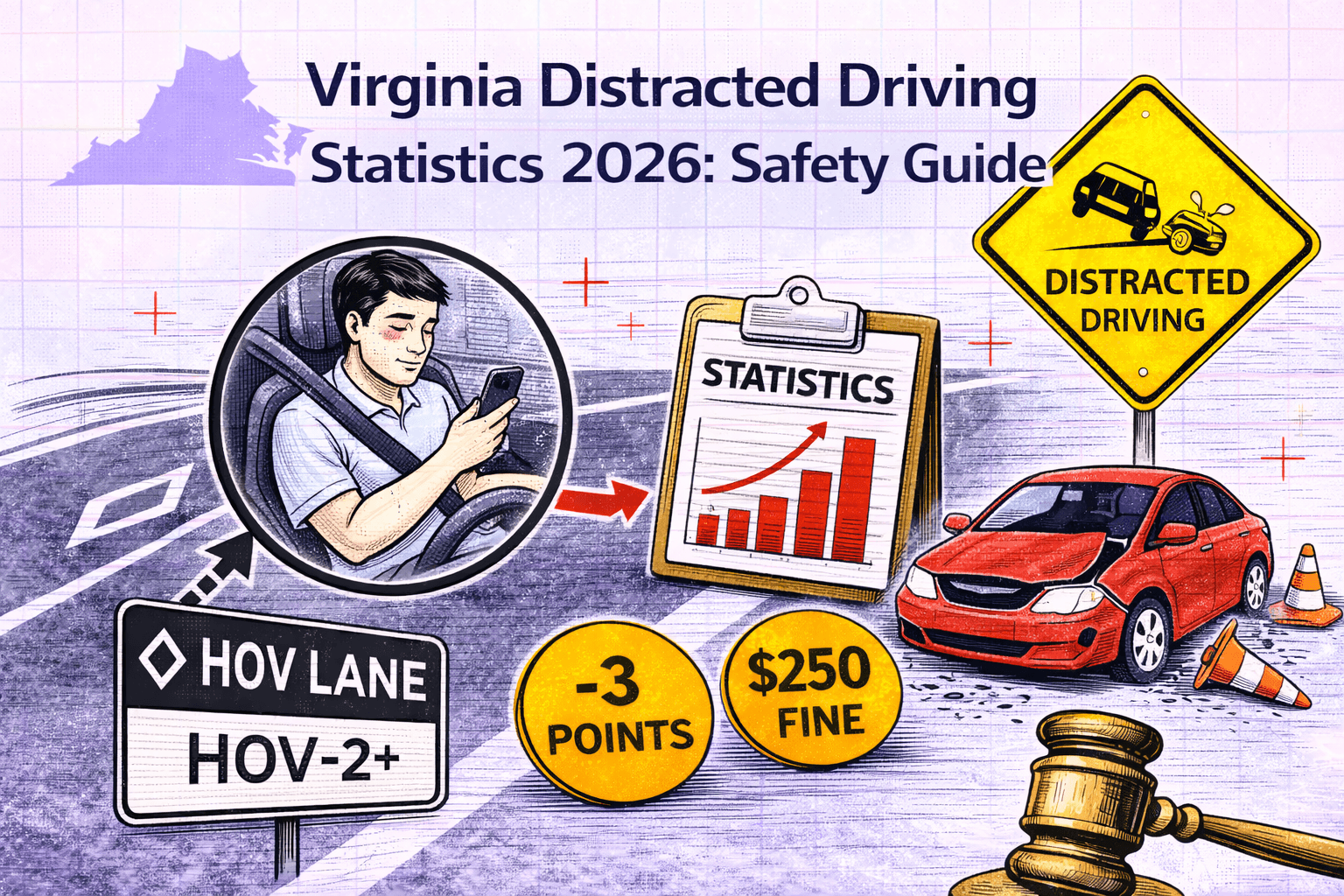
The Growing Crisis of Distracted Driving in Virginia
Distracted driving has become one of the most serious threats to road safety in Virginia and across the United States. Every day, thousands of drivers take their eyes, hands, or attention off the road, putting themselves and others at risk. The consequences can be devastating—from minor fender benders to fatal crashes that destroy families and communities.
Understanding the scope of the distracted driving problem, Virginia's laws against it, and practical strategies to stay safe is essential for every driver on Virginia's roads. This comprehensive guide explores the latest statistics, the types of distractions, legal consequences, and proven techniques to minimize distraction while driving.
Distracted Driving Statistics in Virginia
Crashes and Fatalities
Virginia's distracted driving problem is substantial. According to Virginia State Police data and NHTSA (National Highway Traffic Safety Administration) reports:
Approximately 3,000+ distraction-related crashes occur annually in Virginia
An estimated 60+ fatalities per year are attributed to distracted driving
Thousands more suffer serious injuries in distraction-related accidents
Over 18,000 distraction-related crashes result in non-fatal injuries
These statistics represent real people—drivers, passengers, pedestrians, and cyclists whose lives are changed or ended by a moment of inattention. What makes these crashes particularly tragic is that they're completely preventable.
National Context
Virginia's statistics align with national trends. The NHTSA reports that nationwide, approximately 3,142 people were killed in motor vehicle crashes involving distracted driving in 2020. That's roughly 9% of all fatal crashes. Virginia's numbers track closely with national averages, indicating this is a widespread issue affecting all states.
Age Groups Most Affected
Certain demographics are more likely to be involved in distracted driving crashes:
Teen drivers (16-19 years): Highest crash involvement rate per mile driven; most susceptible to peer influence
Young adults (20-29 years): Heavy cell phone use while driving; second highest crash rate
Drivers aged 40+: Often overconfident in their ability to multitask safely
Teens are particularly vulnerable because their brains are still developing executive function and decision-making capabilities, making them more likely to underestimate risks.
Types of Distracted Driving
Visual Distractions
Visual distractions take your eyes off the road. Examples include:
Looking at your cell phone
Reading text messages or emails
Watching videos
Looking at passengers or objects in the car
Adjusting dashboard controls or GPS
Looking at roadside billboards or scenery
Eating or drinking
Even glancing at your phone for 2-5 seconds is dangerous. At highway speeds (55 mph), looking away for 5 seconds means you travel about 385 feet (nearly 1.5 football fields) without seeing the road—plenty of time for a crash to occur.
Manual Distractions
Manual distractions take your hands off the steering wheel. These include:
Holding and texting on a cell phone
Eating or drinking
Adjusting radio controls
Reaching for objects
Grooming (applying makeup, brushing hair)
Pets or children in the vehicle
Reading maps or other documents
Your hands are critical for maintaining vehicle control, especially during emergency maneuvers. Removing both hands from the wheel significantly reduces your ability to respond quickly to dangers.
Cognitive Distractions
Cognitive distractions take your mind off the road. These are often the most dangerous because you may be looking at the road while your attention is elsewhere:
Thinking about work or personal problems
Emotional stress or distress
Daydreaming or mind-wandering
Conversations with passengers
Listening to music or podcasts that demand attention
Using hands-free phone systems (still distracting cognitively)
Fatigue and drowsiness
Cognitive distractions are insidious because they're invisible—a driver can appear to be paying attention while their mind is elsewhere, making them unaware of hazards developing around them.
Virginia's Distracted Driving Laws
Cell Phone and Texting Laws
Virginia has strict laws prohibiting cell phone use while driving, particularly texting. Key laws include:
Text messaging ban: It is illegal for any driver to send, read, or write text messages while operating a motor vehicle
Handheld device ban: Drivers cannot hold a wireless communications device while operating a vehicle except in emergencies
Teen driver restrictions: Drivers under 18 cannot use cell phones while driving, even hands-free
School bus zone restrictions: Drivers cannot use cell phones in school bus zones
Penalties for Violations
Violating Virginia's distracted driving laws carries significant penalties:
First offense: Fine up to $125
Subsequent offense: Fine up to $250
Court costs: Additional fees depending on jurisdiction
Demerit points: Violations add points to your driving record
License suspension: Accumulating points can lead to suspension
Insurance increases: Moving violations typically increase premiums
If a distracted driving incident results in an accident causing injury or death, charges can escalate to reckless driving, hit-and-run, or manslaughter, carrying far more serious consequences.
Distracted Driving vs. Drunk Driving: Comparing the Risks
Research shows that distracted driving is comparable to drunk driving in terms of crash risk. Studies indicate:
Texting while driving: Increases crash risk by 23x compared to non-distracted driving
Drunk driving (0.08% BAC): Increases crash risk by roughly 3x compared to non-distracted driving
Talking on phone while driving: Increases crash risk by 4x
Texting while driving is actually more dangerous than driving with a blood alcohol content at the legal limit. Yet many drivers view texting as a minor risk while understanding drunk driving as serious. This attitude must change.
When you text while driving, you engage in all three types of distraction simultaneously—visual (looking at phone), manual (hands off wheel), and cognitive (attention on message). This triple threat makes texting one of the most dangerous driving behaviors.
How Distracted Driving Affects Your Brain and Reaction Time
When you're distracted while driving, your brain cannot fully process the driving task. Research shows:
Tunnel vision: Distracted drivers miss hazards in their peripheral vision
Slower reaction time: Response to obstacles increases from 0.5 seconds to 1+ seconds
Reduced situational awareness: You miss the "big picture" of traffic conditions
Impaired decision-making: Your ability to judge speed, distance, and safety decreases
At 60 mph, a 1-second delay in response means you travel an additional 88 feet before braking. That extra distance can be the difference between avoiding a crash and causing a fatal collision.
Technology Solutions for Distracted Driving Prevention
Phone Apps That Block Distractions
Several smartphone apps are designed to minimize distraction while driving:
Driving Mode: Built into many phones, this feature silences notifications and calls
Life360: Offers family location sharing with driving safety features
Drivemode/Android Auto: Simplifies phone interface to essential driving functions only
DriveSafe.ly: Reads text messages and emails aloud instead of forcing you to read them
Cellcontrol: Enterprise solution that parents can use to restrict teen phone use while driving
Vehicle-Based Safety Features
Many modern vehicles include built-in technologies to reduce distraction:
Hands-free calling and texting
Voice-activated navigation
Integrated infotainment systems designed for minimal attention
Adaptive cruise control
Lane-keeping assistance
Automatic emergency braking
Employer Policies
Many employers have implemented distracted driving policies to reduce liability and protect employees:
Cell phone policies prohibiting use while driving company vehicles
Telematics systems that monitor driver behavior
Driver education programs including distracted driving awareness
Incentive programs rewarding safe driving
Progressive discipline for violations
Employer Liability for Distracted Driving
Employers can face significant liability if an employee causes an accident while distracted during work-related driving. Courts have found employers liable for:
Medical expenses for injured parties
Vehicle damage
Lost wages and disability
Punitive damages in cases of gross negligence
Because of this liability exposure, employers increasingly implement strict distracted driving policies and require employees to complete safety training.
Practical Strategies to Avoid Distracted Driving
Before You Drive
Set up your phone: Enable Do Not Disturb or Driving Mode before starting the engine
Program your GPS: Enter your destination and check directions before leaving
Adjust climate controls: Set temperature, air flow, and vents before driving
Select music: Create a playlist or select a radio station before starting
Tell passengers your expectations: Let them know you won't be available for conversation during complex driving
While You Drive
Keep both hands on the wheel: Your hands should be positioned at 9 and 3 o'clock for maximum control
Keep eyes on the road: Check mirrors regularly, but keep your primary focus ahead
Resist phone temptation: Don't glance at notifications—you can check them when you stop
Avoid eating or drinking: If hungry, pull over safely to eat
Minimize conversation: Don't engage in emotionally intense discussions while driving
Manage passengers: If passengers are distracting, ask them to reduce noise level
Stay alert to fatigue: If you're tired, pull over or switch drivers
For Teen Drivers
Parents and teen drivers should establish clear expectations:
No phone use policy: Make it clear that phones must be stowed during driving
Graduated driving privileges: Limit passengers and driving times for inexperienced drivers
Model safe behavior: Parents should never use phones while driving
Discuss peer pressure: Talk about how to handle situations where friends want to distract you
Lead by example: Consistent enforcement of rules teaches the seriousness of safe driving
The Role of Defensive Driving Education
Defensive driving courses teach practical techniques to avoid crashes, including distraction management. These courses emphasize:
Maintaining focus on the driving task
Recognizing distractions before they compromise safety
Reducing risky multitasking behaviors
Improving hazard perception and reaction time
Understanding the cognitive load of various driving conditions
ABC Driving Improvement's Virginia DMV-approved defensive driving course covers comprehensive distracted driving education. Our 8-hour, 100% online program teaches evidence-based techniques to maintain focus and avoid distractions while driving. The course includes modules on:
How your brain processes driving tasks
Types of distractions and their specific risks
Technology solutions for minimizing phone distractions
Strategies for managing passengers and vehicle controls
Practical exercises to improve awareness and reaction time
At just $74.99, the course is an investment in your safety and the safety of others on Virginia's roads.
What to Do If You See a Distracted Driver
If you notice another driver engaging in distracted driving behaviors:
Increase your following distance: Give them extra space to recover if they swerve
Stay calm: Don't engage in aggressive honking or gesturing
Change lanes if safe: Move away from the distracted driver
Report serious incidents: If you witness a crash or dangerous behavior, call 911
Don't retaliate: Never escalate the situation with your own unsafe behavior
Making Virginia Roads Safer
Reducing distracted driving requires individual responsibility, technological solutions, and cultural change. Every driver has the power to make better choices—to resist the urge to check their phone, to eliminate distractions, and to keep their full attention on the road.
Start with your own behavior. Commit to distraction-free driving and encourage others to do the same. If you'd like to deepen your understanding of safe driving practices and how to avoid distraction-related crashes, enroll in ABC Driving Improvement today. Our course provides comprehensive, evidence-based education on distracted driving risks and practical strategies to stay safe. For just $74.99, complete the 8-hour online course at your own pace and gain the knowledge to protect yourself and others on Virginia's roads.
Dismiss Your Ticket Online
Virginia DMV-approved 8-hour driver improvement clinic. Complete at your own pace from any device.
Start Course — $74.99Why Choose ABC Driving Improvement?
Official Virginia clinic
Complete at your own pace, 24/7
Virginia drivers served
Based on verified reviews
Which Course Code Do You Need?
Check your court paperwork or DMV letter for your assigned code.
Get Your Certificate