Virginia's 3-Foot Bicycle Passing Law: What Every Driver Needs to Know
Get Your CertificateLearn Virginia's 3-foot bicycle passing law, the fines for violations, and how a driver improvement course can protect your record.
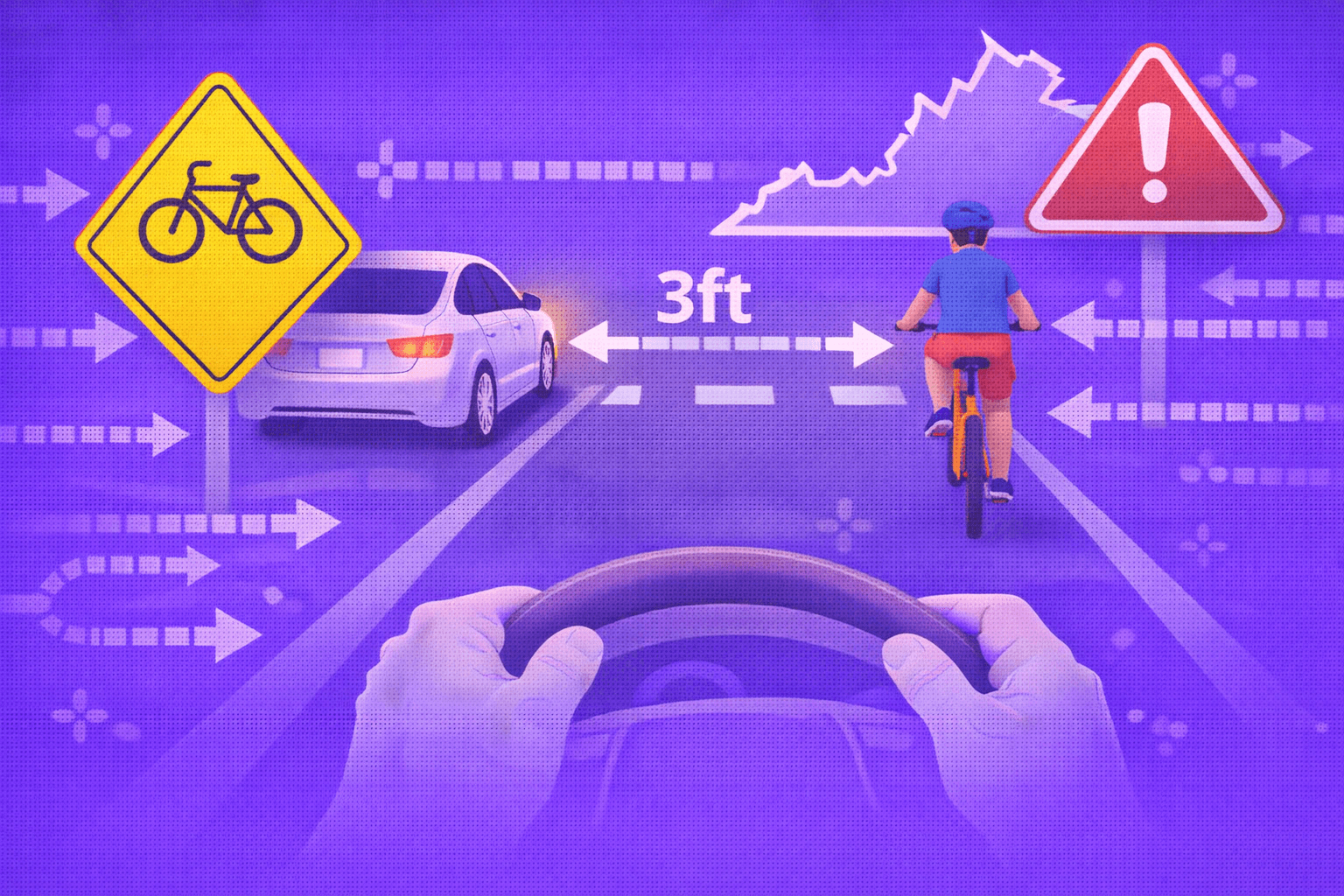
Virginia's Bicycle Passing Law: The Basics
If you drive in Virginia, there's a traffic law that many motorists overlook — and getting caught violating it can mean demerit points on your license and a fine. Virginia Code § 46.2-839 requires drivers to give bicyclists a minimum of three feet of clearance when passing. This is commonly called the "three-foot rule," and it applies any time a motor vehicle overtakes a cyclist traveling in the same direction on a public roadway.
The law isn't just about courtesy — it's about survival. Cyclists have no metal frame to protect them in a collision, and even a glancing strike from a side mirror at highway speed can be fatal. Understanding this rule protects both you and the people sharing the road with you.
What the Law Actually Says
Virginia Code § 46.2-839 states that when overtaking a bicycle, the driver of a motor vehicle shall pass at a safe distance, which shall be not less than three feet, to the left of the bicycle. If the roadway is too narrow to safely allow a three-foot gap, the driver must slow and follow the cyclist until it is safe to pass with adequate clearance.
This means that on narrow two-lane roads, you may need to wait behind a cyclist — even if it feels frustrating — until oncoming traffic clears and you can swing wide enough to meet the three-foot minimum. Attempting to squeeze by in a tight space is not just dangerous; it's illegal.
Virginia joins more than 40 states with explicit minimum-distance bicycle passing laws — and enforcement is increasing as cycling becomes more popular on Virginia roads.
Penalties for Violating the 3-Foot Rule
Violating Virginia's bicycle passing law is classified as a traffic infraction. The consequences include a fine of up to $100 and demerit points assessed to your Virginia driving record. If the violation results in injury to a cyclist, the penalties can escalate significantly, potentially reaching the level of a criminal misdemeanor.
Even a single set of demerit points can have ripple effects. Virginia's point system means that accumulating enough demerits within a certain timeframe can trigger mandatory action by the DMV, including required enrollment in a driver improvement course or even license suspension. You can learn more about how the Virginia DMV demerit point system works to understand your risk.
How Cyclists Fit Into Virginia Traffic Law
Virginia law treats bicycles as vehicles. Cyclists have the right to ride on most public roads, and they are entitled to use the full lane when necessary for their safety — for example, to avoid road hazards, parked cars, or when the travel lane is too narrow to share side-by-side safely. This is called "taking the lane," and it's perfectly legal.
Drivers often get frustrated when a cyclist rides in the center of the lane rather than hugging the right edge, but in many cases the cyclist is doing exactly what the law permits. Honking, cutting off, or making an unsafe pass in response is not only dangerous — it could result in a moving violation on your record.
Practical Tips for Passing Cyclists Safely
Staying on the right side of the law is easier than you might think. Here are some practical habits to adopt:
Check oncoming traffic before passing. If there's not enough room on a two-lane road to swing three feet to the left while staying in your lane, wait until oncoming traffic clears.
Slow down before you pass. At lower speeds, the risk of injury from a close pass is substantially lower, and you have more reaction time if the cyclist swerves.
Use your mirrors and check your blind spots. Cyclists can accelerate quickly on downhill stretches and may be closer than they appear.
Don't "buzz" cyclists. Passing within inches of a cyclist at highway speed is extremely dangerous and is the type of behavior that draws traffic citations and, in serious cases, criminal charges.
Be patient in bike lanes. When turning right across a bike lane, yield to cyclists traveling straight before completing your turn.
How a Driver Improvement Course Can Help
If you've received a traffic citation related to bicycle passing or any other moving violation, enrolling in a Virginia DMV-approved driver improvement course is one of the smartest moves you can make. Completing the course can earn you positive safe driving points on your Virginia record, which help offset demerit points from violations.
At ABC Driving Improvement, our 8-hour online driver improvement course is fully approved by the Virginia DMV, covers Virginia-specific traffic laws (including rules about sharing the road), and can be completed entirely at your own pace from any device. The course costs just $74.99 — a small investment compared to the long-term cost of rising insurance premiums or a suspended license.
Even if you haven't received a ticket, many Virginia drivers choose to take the course voluntarily to earn five positive safe driving points and potentially lower their car insurance rates. Insurers often offer discounts to drivers who complete approved courses — you can read more about how a driver improvement course can lower your car insurance in Virginia.
Frequently Asked Questions
Does the 3-foot rule apply on highways and interstate roads?
The three-foot bicycle passing rule under Virginia Code § 46.2-839 applies on public roads generally. However, bicycles are typically prohibited from fully controlled-access highways (like most interstates), so in practice the law primarily applies to state routes, secondary roads, and urban streets where cyclists are legally permitted to ride.
What happens if I hit a cyclist while passing too closely?
If a driver strikes a cyclist while making a close pass, the driver may face charges ranging from a traffic infraction to a criminal misdemeanor, depending on the severity of injury. Civil liability for damages is also likely. This is why maintaining a safe passing distance is so important — the stakes go far beyond a simple fine.
Can I pass a cyclist using the oncoming lane?
Yes, if it is safe to do so. Virginia law allows drivers to briefly use the opposing lane of traffic to give cyclists adequate passing space, provided it is safe and legal to do so at that location (i.e., you are not in a no-passing zone and oncoming traffic permits). Always check for oncoming vehicles before crossing the centerline.
Ready to Protect Your Driving Record?
Whether you've received a ticket or simply want to brush up on Virginia traffic laws, ABC Driving Improvement is here to help. Our Virginia DMV-approved 8-hour online driver improvement course covers the full range of state traffic laws in a friendly, easy-to-understand format. Enroll today for just $74.99 and take control of your driving record from the comfort of home.
Dismiss Your Ticket Online
Virginia DMV-approved 8-hour driver improvement clinic. Complete at your own pace from any device.
Start Course — $74.99Why Choose ABC Driving Improvement?
Official Virginia clinic
Complete at your own pace, 24/7
Virginia drivers served
Based on verified reviews
Virginia law requires drivers to give cyclists at least three feet of space when passing — violating this rule can cost you demerit points and a fine.
Which Course Code Do You Need?
Check your court paperwork or DMV letter for your assigned code.
Get Your Certificate