Driving in Rain & Fog in Virginia: Essential Safety Tips
Get Your CertificateMaster Virginia's wet weather driving laws and safety techniques. Learn about hydroplaning, fog driving, and rain safety statistics.
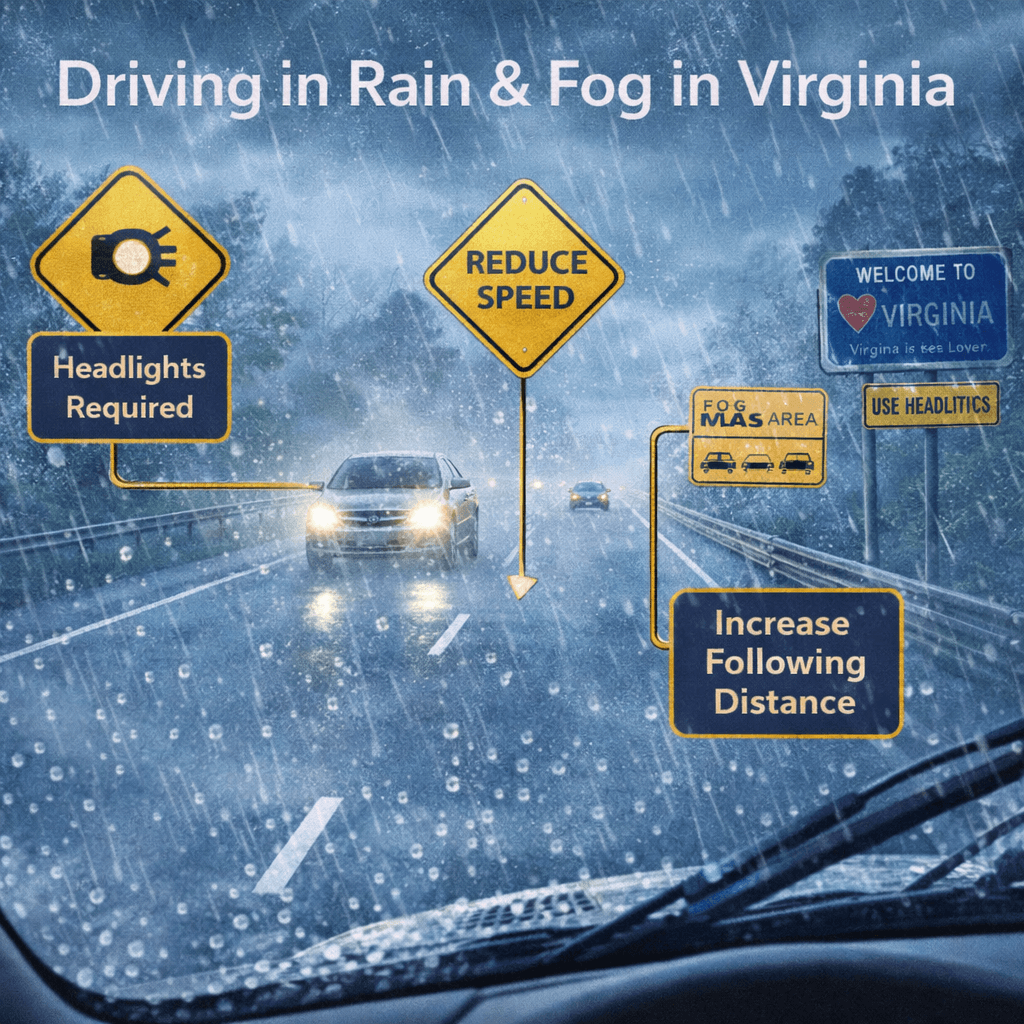
Virginia's Wet Weather Driving Challenges
Rain and fog are common weather conditions in Virginia, particularly during spring and fall months when weather patterns change rapidly. Many drivers underestimate the dangers posed by wet weather, assuming their vehicles will handle normally even when visibility is reduced or traction is compromised. The reality is that rain and fog dramatically increase accident risk, and Virginia drivers need specific knowledge to navigate these conditions safely.
According to Virginia crash data, wet weather contributes to thousands of accidents annually, many of which are preventable through proper technique, awareness, and compliance with Virginia's wet weather driving laws. Understanding how to adjust your driving for rain and fog conditions is essential to protecting yourself, your passengers, and other road users.
Virginia's "Wipers On, Headlights On" Law
One of Virginia's most straightforward but often overlooked wet weather safety laws is the "wipers on, headlights on" requirement. This law is designed to increase visibility during conditions when traction and vision are compromised.
The Legal Requirement
In Virginia, if conditions are wet or visibility is reduced, you must have your headlights on if you're using your windshield wipers. This means that on rainy days or in foggy conditions where wiper activation is necessary, your headlights must also be activated. The law isn't limited to darkness—it applies to any weather condition requiring wipers.
Why This Matters
The purpose of this law is straightforward: when you can't see clearly ahead, other drivers need to see you. Headlights make your vehicle visible to oncoming traffic and vehicles you're approaching from behind. In rain or fog, a vehicle without headlights is nearly invisible to other drivers until they're dangerously close.
Penalties for Non-Compliance
Failing to have your headlights on when your wipers are activated can result in a traffic citation. While this might not be a major violation compared to reckless driving, it's still a preventable offense that indicates inattention to weather conditions. More importantly, driving without headlights in wet conditions significantly increases your accident risk.
Practical Application
Modern vehicles make this requirement easy to comply with. Most newer cars have automatic headlight sensors that turn lights on when wipers activate. If your vehicle doesn't have this feature, develop the habit of checking your headlights whenever you activate your wipers. Make it automatic: wet/foggy conditions = check headlights on.
Understanding and Preventing Hydroplaning
Hydroplaning is one of the most dangerous wet weather phenomena, yet many drivers don't fully understand what causes it or how to respond if it occurs.
What Is Hydroplaning?
Hydroplaning occurs when your vehicle's tires encounter more water than they can disperse, causing a thin film of water to build between the tire and road surface. When this happens, your tires lose contact with the pavement, and you lose traction. Your vehicle essentially floats on water for a moment, and steering, braking, and acceleration become ineffective.
Conditions That Cause Hydroplaning
Hydroplaning is most likely to occur when:
Heavy rain falls: The heavier the rainfall, the more likely hydroplaning becomes.
Your tires are worn: Tread patterns are designed to channel water away from tires. Worn tires have reduced tread depth and can't disperse water effectively.
Pavement has ruts or standing water: Areas where water collects—like depressions in the road or areas with poor drainage—are prime hydroplaning zones.
You're traveling at high speeds: The faster you're going, the less time your tires have to disperse water and the more likely hydroplaning becomes.
Your vehicle is heavily loaded: Extra weight can increase tire pressure on the pavement and paradoxically increase hydroplaning risk by forcing more water to be displaced.
Road surfaces are slick: Newly paved roads or roads with oil residue are particularly prone to hydroplaning.
Signs You're Hydroplaning
Hydroplaning has distinctive characteristics that alert you something is wrong:
Your steering wheel feels light or unresponsive
Your vehicle pulls to one side or the other unexpectedly
Your tires lose grip and your vehicle feels like it's floating
Your speedometer might increase despite your foot position on the accelerator
Your vehicle drifts or slides sideways
What to Do If You Hydroplane
If you experience hydroplaning, your response is critical:
Stay calm: Panic can lead to dangerous overreactions.
Don't brake suddenly: Sudden braking can cause your vehicle to spin. Instead, gradually reduce pressure on the accelerator.
Don't jerk the steering wheel: Avoid sudden steering movements. Keep your wheels pointed in the direction you want to go.
Ease off the accelerator: Slowly reduce your vehicle's speed to allow your tires to regain traction.
Wait for traction to return: As your tires disperse the water, you'll regain grip. Once you feel the tires connecting with pavement, you can brake normally if needed.
Regain control: Once you've regained traction, drive cautiously at reduced speed until conditions improve.
Preventing Hydroplaning Through Proactive Measures
While hydroplaning can happen to anyone in severe conditions, you can significantly reduce your risk:
Maintain Your Tires
Tire tread depth is critical for water dispersal. Check your tires regularly to ensure adequate tread. A simple penny test can help: insert a penny into your tire tread with Lincoln's head upside down. If you can see the top of Lincoln's head, your tread is too worn and should be replaced. Aim for at least 4/32-inch tread depth, preferably deeper.
Reduce Your Speed
The single most effective way to reduce hydroplaning risk is to slow down in wet conditions. High speeds dramatically increase hydroplaning likelihood. In heavy rain, reducing your speed to 45-50 mph (even on highways where higher speeds are normal) significantly reduces risk.
Avoid Puddles and Standing Water
When possible, avoid areas with visible water accumulation. If you can safely change lanes to avoid a puddle or wet area, do so. If you must drive through water, do so slowly and deliberately.
Increase Following Distance
This leads us to our next safety principle: wet weather requires dramatically increased following distances.
Safe Following Distance in Rain
Your ability to stop your vehicle is dramatically reduced in wet conditions. Wet pavement reduces tire grip, and stopping distances increase significantly compared to dry conditions.
The General Rule
In normal dry conditions, the standard safe following distance is three seconds—the time it takes you to reach a point your vehicle ahead of you just passed. In rain, increase this to four to six seconds. This gives you significantly more time to react if the vehicle ahead stops suddenly and provides more distance for your brakes to safely bring your vehicle to a stop.
Calculating Safe Distance
To estimate your following distance: pick a fixed point on the road (a sign, tree, or pavement marking) that the vehicle ahead of you passes. Count the seconds until your vehicle reaches that point. In rain, your count should reach at least four or five seconds before your vehicle reaches the same point. If it's less, you're following too closely.
Why This Matters
Rear-end collisions are extremely common in wet weather because drivers follow too closely. When the vehicle ahead brakes suddenly, drivers in wet conditions don't have enough distance to stop safely. By maintaining four to six seconds of following distance, you give yourself crucial time to brake without collision.
Fog Driving Techniques and Safety
Fog creates unique challenges distinct from rain. While rain reduces visibility from above and creates wet pavement, fog reduces horizontal visibility and can create disorienting visual conditions.
Understanding Fog Hazards
Fog presents several specific dangers:
Reduced visibility: You can't see oncoming traffic, fixed objects, or the road ahead clearly.
Depth perception problems: Fog makes it difficult to judge distances and speeds of other vehicles.
Confusion about speed: In thick fog, you might drive faster than feels safe because visual cues are missing.
Road hazard concealment: Accidents, animals, debris, and other hazards are hidden in fog.
Sudden visibility changes: As you drive, you might suddenly encounter much heavier fog or a patch where visibility is extremely limited.
Fog Driving Best Practices
Use low beams, not high beams: This is a critical principle many drivers get wrong. In fog, high beams reflect off water droplets and reduce your visibility even further. Low beams project light closer to the ground and penetrate fog better. Always use low beams in fog.
Reduce your speed significantly: Fog requires much slower speeds than normal conditions. Even if you can see what feels like an adequate distance ahead, reduce your speed. Road hazards might be hiding in the fog ahead. A reasonable speed in fog is 15-25 mph slower than normal conditions for that road.
Turn on your headlights and fog lights: If your vehicle has fog lights, use them. Combined with low-beam headlights, fog lights provide better visibility in foggy conditions. Ensure your vehicle is visible to others—other drivers might struggle to see you just as you're struggling to see them.
Listen carefully: In thick fog, you might hear vehicles before you see them. Roll down your window occasionally to listen for traffic warnings like horns or engine sounds that indicate approaching vehicles.
Use road markings as guides: White and yellow center line markings become your visual references in fog. Follow them carefully and use them to gauge your position on the road.
Avoid passing: Passing in fog is extremely dangerous because you can't see oncoming traffic. Unless visibility improves significantly, avoid passing maneuvers.
Consider pulling over: If fog becomes so thick that you feel unsafe, pull completely off the road (if safe to do so), turn on your emergency flashers, and wait for conditions to improve. No destination is worth risking your safety.
Virginia's Wet Weather Crash Statistics
Understanding the scope of wet weather accidents in Virginia underscores the importance of adjusted driving techniques. Virginia experiences significant wet weather related accidents:
Frequency and Impact
Wet weather contributes to approximately 20-25% of Virginia's annual motor vehicle accidents. Rain-related accidents account for a substantial portion of injury and fatal crashes during spring and fall months when precipitation is most frequent.
Common Wet Weather Accident Types
Wet weather accidents in Virginia frequently involve:
Hydroplaning and loss of control: Single-vehicle accidents where drivers lose traction on wet pavement.
Rear-end collisions: Accidents where following vehicles don't stop in time due to reduced braking capability.
Multi-vehicle pile-ups: Chain-reaction accidents common on highways where reduced visibility leads to sudden congestion.
Run-off-road accidents: Vehicles sliding off the road due to loss of traction.
The Cost
Wet weather accidents result in significant economic costs through property damage, injuries, and fatalities. These statistics emphasize that wet weather driving requires your full attention and adjusted techniques.
Tire Maintenance for Wet Road Safety
Your tires are your only contact with the road. In wet conditions, proper tire maintenance becomes even more critical.
Tread Depth
As mentioned, tread depth is essential for water dispersal. Check tread regularly and replace tires when they reach 4/32-inch depth. Consider replacing them at 6/32-inch to ensure optimal performance in wet conditions.
Tire Pressure
Underinflated tires can't maintain proper contact with the pavement and are more prone to hydroplaning. Check tire pressure monthly and maintain the inflation recommended by your vehicle's manufacturer (found on a sticker inside the driver's door jamb, not on the tire itself).
Tire Condition
Inspect tires for uneven wear, bulges, cracks, or embedded objects. Any of these conditions compromise wet weather performance. Have questionable tires inspected by a professional.
When to Pull Over
Knowing when conditions are too severe to continue driving is an important safety skill. Consider pulling over when:
Visibility is so reduced that you can barely see the road ahead
You've experienced hydroplaning and feel unsafe continuing
Heavy rain makes it difficult to see beyond a few car lengths
Fog is so thick that you feel you're driving blind
You feel anxious or uncertain about conditions
Your vehicle begins showing signs of mechanical distress in wet conditions
If you decide to pull over, find a safe location completely off the roadway, turn on your emergency flashers, and wait for conditions to improve. Your safety is more important than reaching your destination on time.
Defensive Driving Education and Wet Weather Skills
Wet weather driving is a key component of defensive driving education. Professional instruction in weather-related hazards, vehicle control techniques, and decision-making can significantly improve your safety. ABC Driving Improvement's comprehensive 8-hour Virginia DMV-approved online course includes extensive coverage of weather-related driving hazards, including hydroplaning prevention, fog driving techniques, and weather-adjusted following distances. For just $74.99, you'll gain knowledge and skills to navigate Virginia's wet weather conditions safely. Many insurance companies also offer discounts for completing approved defensive driving courses. Enroll today at ABC Driving Improvement and drive with confidence in any weather.
Conclusion
Virginia's wet weather conditions require adjusted driving techniques and strict adherence to safety principles. Remember Virginia's "wipers on, headlights on" law—it's a simple requirement that dramatically improves your visibility and safety. Prevent hydroplaning by maintaining tire tread, reducing speed, and avoiding standing water. If hydroplaning occurs, stay calm, reduce accelerator pressure gradually, and maintain steering control. In fog, use low beams instead of high beams, reduce speed significantly, and consider pulling over if conditions become too severe. Maintain your tires properly with adequate tread and correct inflation, and increase your following distance to 4-6 seconds in rain. By following these principles and staying alert to changing conditions, you'll safely navigate Virginia's wet weather and significantly reduce your accident risk.
Dismiss Your Ticket Online
Virginia DMV-approved 8-hour driver improvement clinic. Complete at your own pace from any device.
Start Course — $74.99Why Choose ABC Driving Improvement?
Official Virginia clinic
Complete at your own pace, 24/7
Virginia drivers served
Based on verified reviews
Which Course Code Do You Need?
Check your court paperwork or DMV letter for your assigned code.
Get Your Certificate